

SKU: InnoWave-678CRS
IMX678 Sony Starvis2 8 MP HDR 4K Dual-Interface (WIFI + GigE) Camera
From $418.00Sale Price
Description :
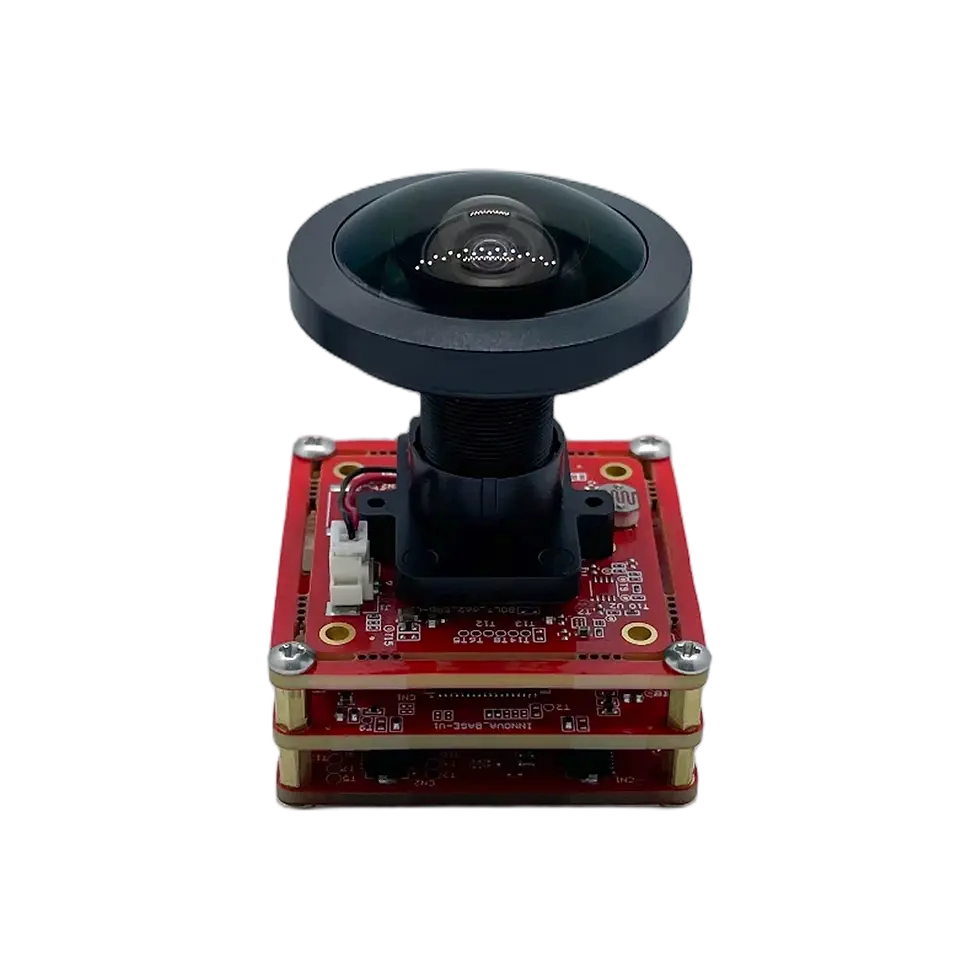
The Vadzo InnoWave-678CRS is a dual-interface security camera built on the Sony STARVIS 2 IMX678 sensor, an 8.4MP CMOS sensor purpose-built for low-light and near-infrared imaging. Its 2.0µm square pixels deliver strong sensitivity even under 0.2 lux conditions, capturing full 3840 × 2160 resolution at up to 30 fps. Built-in HDR modes, Digital Overlap HDR and Clear HDR, extend usable dynamic range in scenes with both bright and shadowed areas. Across its four-board design, the camera integrates both a wired Ethernet (GigE) port and Wi-Fi into a single unit, with seamless switching and automatic fallback if either connection drops, and GigE operating as the default. Together, the sensor's low-light performance and the camera's dual-interface design make it well suited to demanding, always-on security deployments.
Core Benefits:
Sony STARVIS 2 IMX678 sensor, 8.4MP with 2.0µm pixels for strong low-light sensitivity
Full resolution capture (3840 × 2160) at up to 30 fps
Built-in HDR: Digital Overlap HDR and Clear HDR for high-contrast scenes
Enhanced sensitivity in near-infrared (NIR) conditions for night-time imaging
Wi-Fi and Ethernet (GigE) built into a single four-board camera, with seamless switching and fallback
LED flicker mitigation for stable, banding-free footage under flickering LED headlights, taillights, and streetlights.
GigE set as the default interface for stable, low-latency streaming
Variable-speed electronic shutter for flexible exposure control
Purpose-built for security camera applications
Applications:
Security Cameras
Video Surveillance
Night-Time & Low-Light Monitoring
Related Videos:
Product Family InnoWave Series
Camera Model Vadzo InnoWave-678CRS
Sensor IMX678 CMOS Sensor from Sony Starvis2
Sensor Format 1/1.8"
Pixel Size 2.0 µm x 2.0 µm
Max Resolution 8.40MP - 3856(H) x 2180(V)
Shutter Rolling Shutter
Chroma Color
Optics S Mount (M12 Standard) with Auto Switch IR-Cut Filter
Lens FOV Lens-dependent (varies by S-Mount lens selected)
Interface GigE (100Base-T/1000Base-T) and Dual Band Wi-Fi (802.11a/b/g/n/ac)
Connector Standard RJ45 Ethernet Interface
Power Power over Ethernet (Compliance with PoE 802.3af standard 36 to 57V)
Operating Temperature -30⁰C to 70⁰C
Dimension Four Boards: 38mm (L) x 38mm (B)
Weight 35 Grams (Without Lens)
OS Supported Windows, Linux
Conformity OnVIF Compliant, RoHS 3, REACH
Price Details
QUANTITY
UNIT PRICE
NOT INCLUSIVE
50 - 99
$418.00
Lens & Cable
100 - 249
$219.00
Lens & Cable
250+
$192.00
Lens & Cable
Login to Download Datasheet
Datasheet
Download Initiated!
You can download again after 60 seconds.
CAD File
Download Initiated!
You can download again after 60 seconds.
InnoWave-678CRS
Vadzo team shall be able to assist you with the details on this. Reach Vadzo Team for customization & quotation for bulk quantities.
Form Factor Modification & Board Redesigns.
Firmware Modifications to Incorporate Custom Features.
Design & Integration of NIR and Color LED Array Boards.
Design & Integration of Microphones & Speakers.
Design & Integration of Advanced Sensors: ToF, mmWave Radar, IMU.
Lens Holder Modifications & Electro-Mechanical Lens Filter Control.
Enclosure Design & Manufacturing: IP-Rated and Non IP-Rated.
Experience Our Software Suite
Vadzo NXT is a software suite designed for seamless integration and control of GigE & Wi-Fi cameras. It provides precise camera configuration, real-time imaging adjustments, and firmware update management for Windows, and Linux platforms. The SDK ensures reliable performance with features like Region of Interest (ROI) configuration, Smart GPIO control, and fail-safe firmware updates.

Vadzo NXT Software
NXT SDK: GigE & Wi-Fi Camera Control and Integration
Vadzo NXT SDK enables real-time streaming, codec control, and onboard storage management for GigE and Wi-Fi cameras. It supports camera functions, SMART IO, and secure firmware updates with API integration.
Windows
Android
Linux

Both are natively integrated into the four-board camera assembly. Neither interface requires an external module.
What are the video formats supported by the camera?
Sony STARVIS 2 IMX678, 8.4MP. It maintains usable output at 0.2 lux, requiring roughly a quarter of the analog gain compared to the previous-generation IMX334 sensor at equivalent brightness, per Sony's own comparison data.
Digital Overlap HDR and Clear HDR. Both extend dynamic range for high-contrast scenes; specific implementation details depend on ISP configuration downstream of the sensor.
It's a real spec. STARVIS 2 sensors are characterized for both visible and near-infrared response, which is why they pair effectively with IR illuminators for night imaging.
Automatic fallback to Wi-Fi, no manual reconnects required.
GigE, by default, for lower latency and more predictable bandwidth than Wi-Fi.
Electronic shutter with variable charge-integration time, adjustable in 1H-unit resolution steps.
Purpose-built. The datasheet's stated application scope is security cameras specifically.
Yes, the GigE interface operates independently; Wi-Fi isn't required for the camera to function.
Sites with existing Ethernet infrastructure use GigE for stability; sites without it use Wi-Fi. Same hardware, no need to stock two SKUs.
.webp)

.webp)

.webp)