What Is NIR Imaging & How Does NIR Camera Technology Work?

Updated: 1 day ago

NIR imaging is the capture of near-infrared light wavelengths between 700 nm and 1,400 nm that exist beyond the reach of human eyes. An NIR camera works by removing the IR-cut filter from a CMOS sensor, enabling it to detect reflected or emitted near-infrared light with high sensitivity. The result is sharp, high-contrast imaging in complete darkness, through certain materials, and in variable lighting, making NIR imaging essential for surveillance, biometrics, agriculture, and industrial machine vision.
What is NIR imaging?
NIR imaging exists just beyond the limits of human sight.
The human eye sees only visible light (400 - 700 nm).
NIR exists just beyond this, in the near-infrared spectrum.
It is invisible yet always present.
This is why:
Plants reflect NIR strongly.
Materials reveal hidden structures.
Darkness loses its dominance.
In truth, NIR imaging is not about seeing more light. It is about seeing different truths.
You believe you see the world around you. You trust your eyes. You build your systems on what they report. And your cameras, your standard, capable cameras, faithfully reproduce what your eyes would see. But understand this clearly: What your eyes perceive is not all that exists. The light that carries information is far wider than the narrow band your senses were built to receive. Near-infrared lights, the band from 700 nm to 1,400 nm, have always been present. In sunlight. In the warmth of living tissue. In the molecular signature of every surface you have ever touched. It is not hidden. It simply falls outside the boundary of what you were designed to see. NIR imaging does not create new information. It reveals what was already there.
In this guide, you will understand what NIR imaging truly is, how NIR cameras are built to perceive what your eyes cannot, why the choice of sensor and wavelength determines everything, and which embedded NIR camera solutions from Vadzo Imaging carry this capability into your product.
What Is NIR Imaging? Seeing Beyond the Visible
Your eye detects light between 380 nm and 700 nm. This is the visible spectrum of the boundary your biology has drawn.
NIR imaging operates in the band from 700 nm to 1,400 nm. This is near-infrared light: not heat radiation, not X-rays, not microwave energy, simply photons that oscillate at a frequency just below red visible light.
This distinction matters more than most engineers initially realize.
The Spectrum You Were Never Shown
Spectrum Band | Wavelength | Detected By |
Visible Light | 380 - 700 nm | Human eye + standard camera |
Near-Infrared (NIR) | 700 - 1,400 nm | NIR camera (IR-cut filter removed) |
Short-Wave IR (SWIR) | 1,400 - 3,000 nm | InGaAs or cooled sensors |
Thermal Infrared | 8,000 - 14,000 nm | Thermal / LWIR camera |
Notice that NIR Imaging is not thermal. Thermal cameras detect heat emitted from objects they work with, even in the absence of all external light sources. NIR cameras, by contrast, detect reflected near-infrared light, exactly as a visible-light camera detects reflected white light.
This difference makes NIR cameras far more affordable, compact, and practical for embedded deployment while delivering image quality far superior to thermal for applications that require recognizable detail.
How Does an NIR Camera Work? The Mechanism of Expanded Perception
This is where most explanations become vague. Let us be precise.
Every standard camera sensor, CMOS or CCD, is naturally sensitive to light from roughly 350 nm to 1,050 nm. Silicon itself responds to near infrared. But a standard camera contains an IR-cut filter mounted in front of the sensor. This filter blocks all wavelengths above approximately 650 nm.
Why? Because the camera was designed to reproduce what your eyes see. The IR-cut filter ensures colors appear natural. Without it, a red rose in sunlight would look white, because near-infrared imaging reflects from it so strongly.
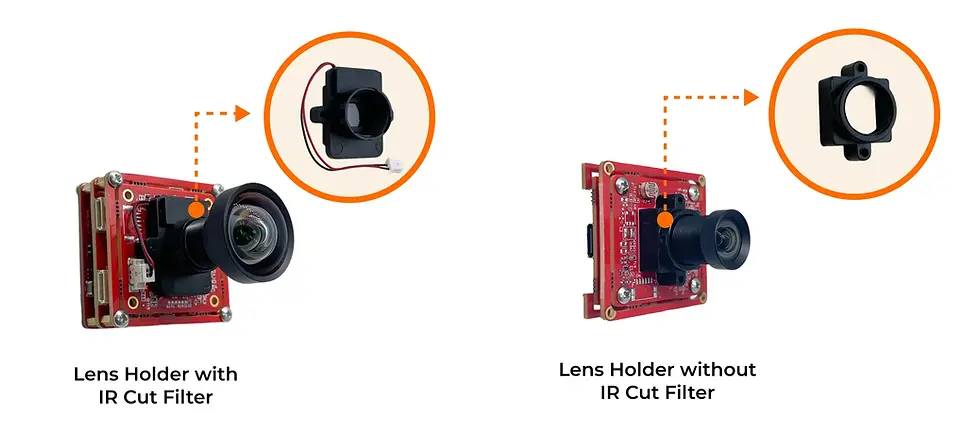
An NIR camera removes that filter. That is the fundamental act. The same CMOS sensor that was always capable of receiving near-infrared light is now free to do so. What was blocked is now perceived.
The Four Steps: From Darkness to Data
Step 1 Illumination: Near-infrared light from sunlight, ambient sources, or a dedicated NIR LED illuminator (850 nm or 940 nm) falls on the subject. This light is present even when a room appears completely dark to your eyes.
Step 2 Differential Reflection: Different materials reflect NIR wavelengths at different intensities. Human veins absorb NIR and appear dark against the surrounding tissue that reflects it. Healthy vegetation reflects NIR strongly; stressed plants do not. Silicon wafers transmit NIR above 1,000 nm, allowing imaging entirely through them.
Step 3 Sensor Capture: The CMOS sensor, free from its IR-cut filter, receives the reflected NIR photons. Monochrome sensors without the Bayer color mosaic deliver superior NIR sensitivity because the color filter array absorbs a portion of near-infrared before it reaches the photodiodes.
Step 4 Output: The captured data is processed and output, typically as Y8 (8-bit greyscale) or Y16 (16-bit greyscale). The result is a sharp, high-contrast monochrome image, even in conditions of complete visible-light darkness.
850 nm vs 940 nm: Which Wavelength Should You Choose?
This question arrives early for every engineer designing an NIR-based system. The answer depends on whether you need your illumination to be seen.
850 nm illuminators emit a faint red glow visible to human eyes. Operators can confirm the illuminator is active. Used in most standard NIR surveillance cameras and biometric scanners.
940 nm illuminators are completely invisible to humans. Preferred for covert surveillance, facial recognition in consumer devices, and applications requiring zero visual disturbance. Slightly lower NIR Imaging sensor QE at this wavelength accounts for this in your illuminator power calculations.
Vadzo's AR0521- and AR0522-based NIR camera modules deliver strong quantum efficiency response at both 850 nm and 940 nm. Consult the sensor QE curves in the datasheet before finalizing your illuminator wavelength.
The Components That Define NIR Camera Performance
You can place two cameras side by side, both labelled 'NIR-capable', and observe a profound difference in image quality. The difference lies in these components.
1. The CMOS Sensor: The Foundation of Perception
Not all sensors are equal in the near infrared. Quantum efficiency (QE), the percentage of photons that produce an electrical signal, determines how well your sensor perceives NIR light at a given wavelength. Onsemi sensors like the AR0521, AR0522, AR0544, and Sony's IMX900 deliver high NIR QE with low read noise, critical for imaging in environments where NIR illumination is constrained.
According to onsemi's published datasheet, AR0521 achieves over 35% quantum efficiency at 850 nm, well above the 20-25% typical of consumer-grade CMOS sensors at the same wavelength. This difference manifests as visibly cleaner, lower-noise NIR images in real deployment.
2. The IR-Cut Filter: What You Remove Changes What You See
A standard IR-cut filter blocks all light above 650 nm. For NIR imaging, remove it entirely. For dual visible + NIR systems, replace it with a switchable filter, a mechanical or liquid crystal filter that can flip between standard visible and NIR modes depending on ambient conditions. For dedicated NIR-band applications, replace the IRCF with an NIR bandpass filter (e.g., 850 nm ± 50 nm) that blocks all visible light and passes only your target NIR band.
3. NIR Illumination Providing What the Scene Requires
Sunlight provides adequate NIR illumination outdoors during daytime. Indoors, or at night, your system requires dedicated NIR LED illuminators. These are available as ring arrays, linear bars, or integrated board-level modules. Vadzo Imaging supports custom OEM NIR camera designs with integrated LED board illuminators, eliminating the need for separate illumination hardware in space-constrained deployments.
4. NIR-Transmissive Lenses: An Overlooked Requirement
Standard glass lenses begin blocking wavelengths above approximately 700 - 750 nm. For NIR imaging above 800 nm, your lens must have NIR-transmissive glass and anti-reflection coatings rated for your target wavelength. Always verify lens transmission curves before finalizing your NIR imaging optical design.
Applications Where NIR Imaging Changes Everything
Do not mistake NIR imaging for a specialized, narrow technology. It sits inside systems you interact with daily, often without your awareness.
1. Night Vision Surveillance Seeing When Darkness Seems Complete
A room that appears pitch-black to every human eye contains NIR light from LED fixtures, ambient solar heat, and dedicated NIR illuminators. An NIR surveillance camera captures faces, license plates, and motion in this apparent darkness with the same crispness as daylight footage.
According to a 2024 IHS Market report, over 60% of AI-enabled surveillance cameras deployed globally incorporate NIR-sensitive sensors to ensure around-the-clock operational continuity. The visible-light-only camera is becoming the exception, not the standard.
2. Biometrics: The Vein That Proves Identity
NIR light at 850 nm penetrates the epidermis. Hemoglobin in veins absorbs this light; surrounding tissue reflects it. An NIR camera captures the unique vein pattern in a palm or finger in under 30 milliseconds. This pattern does not change with age, cannot be reproduced from a photograph, and cannot be faked with a prosthetic. It is the biometric identifier that your eyes were never designed to see.
Iris recognition used in border control, banking kiosks, and smartphone unlocking operates on the same principle. NIR illumination at 850 nm reveals fine iris texture detail regardless of iris color, ambient light, or cosmetic contact lenses.
3. Precision Agriculture Health Hidden in Green
A healthy plant and a diseased plant can appear identical under visible light. Under NIR, they cannot. Healthy chlorophyll-filled leaves reflect near-infrared strongly. Stressed or diseased vegetation absorbs it. The Normalized Difference Vegetation Index (NDVI), the ratio of NIR to red reflectance, allows drone-mounted NIR cameras to assess the health of a thousand-acre crop in a single pass, identifying stressed zones days before visible symptoms appear.
4. Industrial & Semiconductor Inspection
Silicon is transparent to NIR light above 1,000 nm. An NIR camera can image through a silicon wafer and detect internal fault structures, voids, and cracks invisible to standard visible-light inspection. In PCB quality control, NIR imaging reveals solder joint integrity beneath conformal coating without removing the coating and destroying the unit.
5. Medical Fluorescence & Wound Imaging
Surgeons inject NIR fluorescent dyes such as Indocyanine Green (ICG) into the bloodstream. Under NIR illumination, these dyes reveal tumor margins, lymph node pathways, and bile duct locations with precision that no visible-light imaging can match. Vadzo's monochrome NIR cameras are suitable for integration into fluorescence-guided surgical imaging systems requiring compact, high-sensitivity embedded sensors.
NIR Camera vs. Standard Camera: The Comparison You Need
The table below is not a competitive comparison. It is a map of two different kinds of perception.
Parameter | Standard Camera | NIR Camera |
Wavelength captured | 380 - 700 nm (visible only) | 700 - 1,400 nm (near-infrared) |
IR-cut filter | Present - NIR blocked | Removed or NIR bandpass. |
Low-light performance | Limited without visible light | Excellent with 850/940 nm LEDs |
Image output | Full color (RGB) | Monochrome (Y8 / Y16) |
Skin penetration | Surface only | 2 mm into the epidermis |
Operation in darkness | No | Yes, with NIR illumination. |
Sensor type (optimal) | Color CMOS (Bayer mosaic) | Monochrome CMOS (no Bayer) |
Vein/iris imaging | Not possible | Core capability |
Vadzo's NIR Camera Solutions
Knowing what NIR imaging is changes how you see your application. Knowing which camera to use and trusting it to perform is a different kind of clarity.
Vadzo Imaging designs and manufactures embedded NIR camera modules built for OEM deployment, AI edge systems, and industrial-grade integration. These are not consumer cameras modified for NIR Imaging. They are purpose-engineered solutions.
Falcon-521MRS 5MP NIR Monochrome USB Camera
AR0521 sensor | USB 3.0 | Y8 output | High NIR QE at 850 nm & 940 nm | Ideal for biometrics, surveillance, and machine vision
Falcon-522MRS 5MP NIR Monochrome USB Camera
AR0522 sensor | USB 3.0 | Y8 output | Optimized low-light NIR sensitivity | Ideal for facial recognition and access control
VAJRA IMX900-MGS 3.2MP Global Shutter NIR
Sony IMX900 | USB 3.2 Gen 2x2 | Quad HDR | Global shutter | NIR @ 850/940 nm | Robotics, AGV, high-speed inspection
AR1335 NIR Autofocus MIPI Camera 13MP
AR1335 sensor | MIPI CSI-2 | Contrast AF | Raspberry Pi / Jetson compatible | Medical, OCR, embedded AI vision
For custom requirements, integrated NIR LED boards, IP-rated enclosures, bespoke form factors, or NIR + HDR combined imaging, contact Vadzo Imaging for an OEM consultation.
Frequently Asked Questions (FAQs)
What wavelength does your application require?
Do you need color output?
Almost certainly not, for NIR-primary systems. Monochrome CMOS sensors deliver significantly superior NIR sensitivity. Colour sensors with Bayer mosaics absorb NIR before it reaches the photodiodes.
What are your resolution and frame rate requirements?
5MP at 30fps covers most biometric and surveillance applications. High-speed robotics or production-line inspection requires global shutter sensors; rolling shutters introduce distortion with fast-moving subjects.
Which interface does your platform use?
USB 3.0 for prototyping, Windows/Linux deployment. MIPI CSI-2 for Raspberry Pi, NVIDIA Jetson, and NXP i.MX. GigE for cable runs beyond 3 metres in industrial settings.
How will your scene be illuminated?
Sunlight provides adequate NIR outdoors in daytime. All other conditions require dedicated 850 nm or 940 nm LED illuminators. Vadzo supports integrated LED array boards for space-constrained OEM designs.
Why NIR Imaging Matters for Modern Embedded Vision Systems
Designing embedded vision systems with NIR technology ultimately demands a shift in how you think about perception. Throughout this guide, you have seen how NIR imaging reshapes illumination strategy, optics selection, sensor response, system bandwidth, and real-world deployment constraints. Each engineering decision, from choosing the right wavelength and lens coating to planning ISP tuning and thermal behavior, determines whether your NIR system simply “works” or delivers reliable, high-contrast intelligence in environments where visible-light cameras fail.
NIR isn’t just an enhancement layer. It is a fundamentally different imaging domain that unlocks capabilities your product could never access in the visible spectrum. And as you incorporate these principles into your design, you’re not just adding night vision or spectral sensitivity, you’re engineering a system that sees with purpose, independent of ambient light and unconstrained by human perception.
Ready to bring NIR imaging into your product?
Vadzo Imaging designs embedded NIR camera modules with USB 3.0, MIPI CSI-2, and GigE for OEM and industrial deployment worldwide.
Which NIR application are you building for surveillance, biometrics, agriculture, or industrial inspection? Share your use case in the comments, or reach out to Vadzo Imaging directly. The team is ready to help you choose and customize the right NIR camera for your system.


