What is High Dynamic Range (HDR) and How Does an HDR Camera Work?

Updated: Jul 25

You are designing a vision system for a smart parking garage. The camera needs to see clearly bright outdoor lanes and dark indoor bays in the same frame, at the same moment. You install a standard camera. It fails. Everything bright burns out. Everything dark disappears.
That gap between what your eye sees effortlessly and what a standard sensor captures is the dynamic range problem. And in 2026, if your embedded vision system operates in the real world, high dynamic range (HDR) is not an upgrade. It is a requirement.
This guide explains exactly what high dynamic range means in imaging, how HDR cameras work at the sensor level, and how to choose the right high dynamic range imaging module for your embedded system.
What is High Dynamic Range (HDR)
Let us start with a simple definition. Define HDR this way: High Dynamic Range is the ability of a camera sensor to capture detail in both the brightest highlights and the darkest shadows of a scene simultaneously, in a single frame.
In imaging science, dynamic range is the ratio between the maximum and minimum luminance values a sensor can record without losing detail. Too much light, the pixel saturates (pure white, no detail). Too little light, the signal drowns in noise (pure black, no detail).
Dynamic range is measured in decibels (dB) or f-stops. The human eye adapts across roughly 120 dB in a scene. A standard CMOS sensor captures 60 - 70 dB. An HDR camera sensor reaches 100 - 120 dB, matching what the human visual system sees naturally.
How Does High Dynamic Range Imaging Work Inside the Sensor?
Standard sensors allocate one fixed exposure time to every pixel in the frame. One exposure, one bet. Either the highlights look good, and shadows go dark, or shadows look good, and highlights blow out.
HDR sensors break this constraint. They use multiple strategies, some mechanical, some electronic, some happening at the pixel level, to capture both extremes at the same time.

Multi-Exposure HDR (Frame-Based Blending)
The sensor captures two or more sequential frames at different exposure times, a long exposure for dark areas and a short exposure for bright areas. These are then blended, pixel by pixel, into a single high dynamic range output image.
This method is effective for static scenes. The risk: motion artifacts. If anything in the scene moves between the two exposures, a vehicle, a person, or a robotic arm, the blended output shows ghosting. For high-speed embedded applications, this is unacceptable.
Single-Exposure HDR iHDR and eSHDR
This is where modern HDR camera sensors genuinely advance the field. Instead of capturing multiple frames over time, single-exposure HDR methods capture long and short integrations within a single frame period.
iHDR (in-pixel HDR): Each pixel contains multiple storage nodes that simultaneously capture a long integration (for shadows) and a short integration (for highlights). The result is combined on-chip before readout. No motion artifacts. Full frame rate maintained.
eSHDR (extended short HDR): A very brief secondary exposure is applied across the entire sensor after the primary exposure, recovering highlight detail that the long integration would otherwise saturate. Simpler circuitry than iHDR. Works well for scenes with predictable bright regions.
Sensors like the onsemi AR0821 and AR0830, both available in Vadzo's HDR camera lineup, implement these techniques to achieve up to 120 dB dynamic range in a single captured frame.
LED Flicker Mitigation (LFM) The Hidden Requirement
LED traffic signals, industrial indicators, and digital signage flicker at 100–120 Hz, following AC power cycles. A camera with a short exposure captures only part of the LED's on-off cycle, producing a black or partially illuminated signal element in the frame.
LFM-enabled HDR cameras synchronize their exposure timing to always capture a complete illumination cycle. Every LED-lit element appears consistent and fully visible in every frame, a critical requirement for traffic monitoring, ADAS, and smart city systems.
Engineering reality check:
If your system reads LED-based traffic signals, warning lights, or digital signage, and your HDR camera does not specify LFM support, you will get intermittent detection failures in production. This is not a software problem. It must be solved at the sensor level.
Multi-Exposure vs. Single-Exposure HDR: Which Fits Your System?
The choice depends entirely on whether your scene has motion. Here is the direct comparison:
Feature | Multi-Exposure HDR | Single-Exposure HDR (iHDR/eSHDR) |
Motion Artifacts | Yes ghosting on fast subjects. | No single frame capture |
Dynamic Range | Up to 100 dB | Up to 120+ dB |
Frame Rate Impact | Reduced (multiple captures) | No reduction |
Processing Complexity | Moderate requires blending | Low on-chip processing |
LFM Capability | Limited | Full LFM support available |
Best For | Document scanning, microscopy, and labs | Traffic, robotics, ADAS, smart city |
Example Vadzo Sensors | Standard sensors | AR0821, AR0822, AR0830, OX03C10 |
Vadzo Innova-678CRS & Innova-662CRS: Sony-Powered GigE Cameras Built for the Demands of Industrial Vision
Now I have enough context about Vadzo Imaging. The Innova-678CRS and Innova-662CRS are GigE camera models based on the Sony IMX678 (8.4MP, 4K HDR) and Sony IMX662 (2.4MP, 1080p) sensors, respectively, following Vadzo's naming convention. Let me write the SEO/AEO paragraph.
Vadzo Imaging brings cutting-edge GigE camera technology to industrial and embedded vision markets with the Innova-678CRS and Innova-662CRS, two purpose-built cameras designed for demanding real-world environments. The Innova-678CRS, powered by Sony's STARVIS 2 IMX678 sensor, delivers 8.4MP 4K resolution with high dynamic range capability, making it a strong fit for applications like traffic monitoring, precision inspection, and AI-driven edge analytics where rich image detail and reliable HDR performance are non-negotiable. The Innova-662CRS, built on Sony's STARVIS IMX662 sensor, targets 2.4MP 1080p use cases that demand ultra-low-light sensitivity, offering clean, noise-free imagery in challenging lighting conditions typical of surveillance, medical imaging, and smart city deployments. Both cameras connect over GigE, enabling long-distance, stable data transfer across factory floors and outdoor infrastructure without sacrificing frame rate or image integrity and both align with Vadzo's wider portfolio of OEM-grade embedded vision solutions that support custom form factors, firmware modifications, and integration with advanced sensors for customers who need a complete, tailored imaging system rather than an off-the-shelf compromise.
Key Specs to Evaluate When Selecting an HDR Camera Module
When you open a datasheet, these are the numbers that determine whether the camera will perform in your actual deployment conditions.
Specification | What It Means | What to Look For |
Dynamic Range (dB) | Ratio of max to min detectable light | ≥ 100 dB for outdoor/variable light |
HDR Mode | How HDR is implemented on-chip | iHDR or eSHDR for motion-present scenes |
LFM Support | LED flicker mitigation capability | Mandatory for traffic, smart city, and ADAS |
Pixel Size (µm) | Physical light collection per pixel | Larger pixels = better low-light SNR |
Operating Temperature | Thermal range for reliable operation | -40°C to +85°C for outdoor deployment |
Interface | Data output connection type | Match to your host platform (USB/MIPI/GigE/SerDes) |
Frame Rate @ Full Res | Speed at maximum resolution | Confirm no frame rate penalty for HDR mode. |
Vadzo HDR Camera Modules: Find the Right One for Your System
Vadzo designs and manufactures high dynamic range camera modules across USB 3.0, USB 3.2, MIPI, GigE, and SerDes/FPD-Link interfaces. Every module is built around proven onsemi HyperLux and OmniVision HDR sensor platforms.
Camera Model | Sensor | Dynamic Range | Best Application | Interface |
AR0821 4K HDR | onsemi AR0821 | 120 dB iHDR | Industrial, Smart City | USB 3.0 / MIPI / SerDes |
AR0822 4K HDR | onsemi AR0822 | 120 dB eSHDR | Outdoor, Traffic | USB 3.0 / MIPI |
AR0830 4K HDR + LFM | onsemi AR0830 | 120 dB + LFM | ADAS, Smart City, Automotive | USB 3.0 / MIPI / SerDes |
OX03C10 HDR + LFM | OmniVision OX03C10 | High DR + LFM | Fleet, Automotive Vision | USB 3.0 / SerDes FPD3/4 |
AR0233 1080p HDR | onsemi AR0233 | High DR 1080p | Compact Embedded Systems | USB 3.0 / MIPI |
AR0246 2MP HDR | onsemi AR0246 | High DR 2MP | Low-Power IoT Devices | USB 3.0 / MIPI / SerDes |
Vadzo HDR Camera Product References
Browse the complete range of Vadzo high dynamic range camera modules across all interfaces:


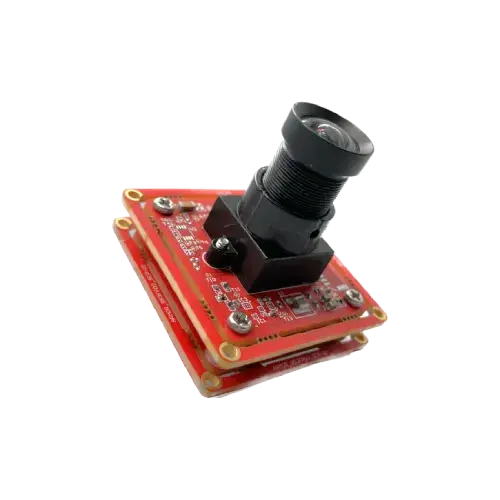


Frequently Asked Questions (FAQs)
What is the difference between iHDR and eSHDR in HDR cameras?
Both iHDR and eSHDR are single-exposure high dynamic range techniques meaning they capture the full dynamic range within one frame period, with no motion artifacts. iHDR (in-pixel HDR) works at the pixel level. Each pixel contains multiple storage nodes that simultaneously hold a long integration (for shadow detail) and a short integration (for highlight detail). The sensor combines them on-chip before readout. eSHDR (extended short HDR) works at the frame level after the primary long exposure, a very brief secondary exposure is captured across the full sensor to recover any highlights that saturated during the primary integration. iHDR offers finer control per pixel. eSHDR is architecturally simpler and performs well in scenes where bright regions are relatively predictable. For motion-heavy deployments traffic, robotics, ADAS both outperform multi-exposure HDR significantly. Vadzo's AR0821 and AR0822 use iHDR and eSHDR respectively, available at vadzoimaging.com.
What does high dynamic range mean on a security or surveillance camera?
On a surveillance or security camera, high dynamic range means the camera can capture usable detail across the full brightness range of the scene not just the average. A standard surveillance camera pointed at a building entrance will either correctly expose the outdoor daylight and lose the indoor lobby detail, or expose for the indoor lobby and blow out everything outside. An HDR surveillance camera captures both simultaneously. For license plate reading, face recognition at entrance terminals, and parking garage monitoring all common security applications high dynamic range imaging is what separates cameras that perform reliably from those that work only under ideal lighting.
Does high dynamic range imaging reduce frame rate in embedded cameras?
It depends entirely on the HDR method used. Multi-exposure HDR where the sensor captures two or more sequential frames at different exposure times does reduce effective frame rate, because multiple captures are required to produce one output frame. Single-exposure HDR methods like iHDR and eSHDR do not reduce frame rate. They operate within a single frame period, capturing everything simultaneously before readout. If your application requires both high dynamic range and high frame rate robotics, fast inspection conveyors, ADAS always specify single-exposure HDR sensors. Vadzo's AR0821 and AR0830 maintain full frame rate in HDR mode.
How do I choose between 100 dB and 120 dB dynamic range for my system?
The choice comes down to your specific scene contrast and deployment environment. For controlled indoor environments with stable, predictable lighting such as document scanning stations, laboratory imaging systems, or kiosk terminals with controlled illumination 70 - 80 dB is often adequate. For outdoor deployments with direct sunlight and shadows in the same frame smart city cameras, building entrance terminals, outdoor inspection systems a minimum of 100 dB is the practical threshold. For automotive and ADAS applications, or any system that must handle both extreme highlights and deep shadows simultaneously tunnel exits, low-angle sun, night-to-day transitions 120 dB with LFM support is the correct specification. When in doubt, design to the harder condition, not the average one.
Can software or ISP processing replace a true HDR sensor in an embedded camera module?
No, not equivalently. Image signal processors and software tone-mapping algorithms can improve the apparent contrast of an image after capture. They work by redistributing the available tonal range more evenly across the output image. But they operate only on data the sensor has already captured. If a pixel was fully saturated at capture receiving more light than its full-well capacity no software can recover what was never recorded. Similarly, if a pixel received so little light that its signal was buried below the noise floor, no post-processing algorithm recovers that detail. True high dynamic range imaging happens at the sensor during capture. Software enhancement is a valid complement to HDR not a substitute for it.
Choosing the Right HDR Technique for Real-World Embedded Vision
High dynamic range is not a premium feature reserved for expensive cameras. It is the correct response to a real-world physics problem, the gap between what real environments contain and what standard sensors can capture.
If your system ever faces variable lighting, direct sunlight, deep shadow, bright LEDs, or reflective surfaces, then defining HDR correctly in your specification is not optional. It is the difference between a vision system that works in the lab and one that works in the field.
The question is not whether you need high dynamic range imaging. It is which HDR technique, iHDR, eSHDR, or LFM, and which interface fits your motion profile, deployment environment, and host platform?


