Autofocus Sensors in Embedded Vision: Precision Imaging for Medical and Industrial Systems

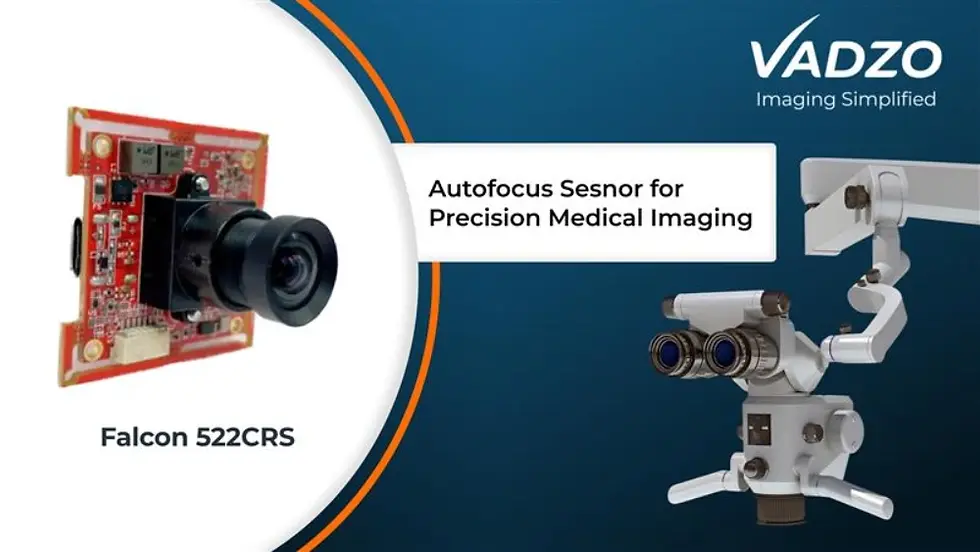
In the design of embedded vision systems, the sharpness of an image determines the dependability of the system. Whether applied in medical diagnostics, industrial automation, or robotic vision, it is essential to keep an accurate focus across different object distances. Autofocus sensors are thus essential components of contemporary embedded cameras, providing flexible, high-precision imaging without the need for manual adjustments.
Understanding Autofocus Sensors
An autofocus sensor automatically adjusts the lens position to bring the subject into the sharpest possible focus. The system relies on a focus metric evaluation loop, where the camera analyzes image sharpness, adjusts the lens through a Voice Coil Motor (VCM) or actuator, and locks onto the optimal focal plane.
Core Autofocus System Components
Lens and VCM actuator: Executes mechanical focus movement
Sensor and ISP feedback loop: Evaluates image sharpness
Control interface: I²C or UVC-based control of focus position
Firmware logic: Defines focus search strategy and stability
Embedded autofocus systems are designed for low-latency focus acquisition, essential for dynamic or precision applications like medical imaging, where the target may move subtly within the field of view.
Working Principles of Autofocus Mechanisms
Different autofocus strategies are used depending on scene dynamics, sensor type, and processing capability.
Contrast Detection Autofocus (CDAF)CDAF evaluates image sharpness directly from captured frames. The lens iterates through focus positions until contrast is maximized.
Advantages: Simple, accurate; no special sensor hardware.
Best for: Medical imaging or stationary inspection setups.
Phase Detection Autofocus (PDAF) PDAF uses dedicated pixels on the sensor to calculate the phase difference between incoming light beams, allowing it to predict lens movement direction and magnitude.
Advantages: Fast, predictive focus.
Best for: Dynamic, fast-moving subjects or robotic applications.
Hybrid Autofocus
Combines CDAF and PDAF, enabling both speed and precision. Hybrid AF is often paired with high-performance ISPs to fine-tune focus for mixed environments.
Time-of-Flight (ToF) or Laser-Assisted AF
Measures actual distance using IR light, giving focus pre-positioning before the optical AF fine-tunes the image.
Best for: Industrial inspection, robotics, and medical instruments where the distance varies rapidly.
Autofocus Sensor in Embedded Vision Systems: Design-Level Considerations
Mechanical & Electrical Integration
Most embedded autofocus modules use VCMs driven by I²C or PWM control signals. Stability and repeatability are achieved through closed-loop calibration, a vital feature for systems exposed to vibration or temperature variations.
Interface Compatibility
Autofocus modules integrate with standard MIPI CSI-2 and USB 3.0 UVC interfaces.
MIPI modules (e.g., Falcon-522CRS) allow direct SoC-level control of focus via kernel drivers.
USB 3.0 modules (e.g., Falcon-5640CRA) provide autofocus over UVC extension units for plug-and-play control on Linux or Windows systems.
Software and ISP Support
Platform-level control of autofocus can be achieved through:
V4L2 controls on Linux for low-level tuning.
ISP autofocus algorithms for continuous focus tracking.
Application-level APIs (e.g., OpenCV) for scene-based control in robotics or inspection.
Why Autofocus Sensors Matter in Embedded Imaging
Parameter | Fixed Focus | Autofocus |
|---|---|---|
Focus Distance | Predefined | Dynamic |
Scene Adaptability | Low | High |
Image Sharpness Consistency | Variable | Optimized per frame |
Integration Complexity | Simple | Moderate |
Performance for Moving Subjects | Poor | Excellent |
Autofocus provides:
Consistent image sharpness across varying distances
Improved depth flexibility for multi-object scenes
Reduced calibration time in production setups
Better low-light focusing capability
Higher throughput for automated inspection systems
After observing how autofocus improves overall imaging effectiveness, let’s examine how it provides tangible benefits in medical and patient-care systems where accuracy is essential.
Autofocus Sensor in Medical Imaging and Patient-Care Devices
Medical imaging requires absolute precision. Autofocus sensors enable:
Dermatology cameras that adjust to skin curvature and distance.
Microscopic and endoscopic systems maintain clarity at micro distances.
Telemedicine cameras that compensate for patient movement during live sessions.
In these systems, autofocus ensures consistent diagnostic image quality without operator intervention, reducing time and improving reliability for clinicians.
Vadzo Imaging’s Falcon-5640CRA (based on Sony IMX564) and Falcon-522CRS (Sony IMX522) modules are prime examples combining high-resolution imaging with fast autofocus performance ideal for medical diagnostics and optical instrumentation.
Industrial and Automation Applications
In industrial environments, autofocus sensors help maintain imaging accuracy even when object distances or lighting vary. Applications include:
PCB inspection where component height varies by millimeters.
Barcode and label reading at variable distances.
Robotics vision where the focus must adjust to moving parts.
The Falcon-1335CRS, featuring the Sony IMX335 sensor, brings autofocus capability to compact embedded vision systems with excellent low-light performance, making it suitable for both smart retail and factory automation.
Having established essential medical and industrial applications, the following step is to comprehend the engineering factors that affect the choice and integration of autofocus sensors.
Engineering Guidelines for Selecting Autofocus Sensors
When integrating autofocus modules, engineers should evaluate these key parameters:
Parameter | Consideration |
|---|---|
Focus Mechanism | VCM stroke, precision, hysteresis |
Lens Characteristics | FOV, aperture, IR filter, distortion |
Sensor Format | Pixel size, sensitivity, and HDR capability |
ISP and Platform Support | Autofocus algorithm tuning, latency |
Thermal Stability | Focus drift management for industrial environments. |
Vadzo Imaging’s autofocus modules are pre-calibrated, minimizing integration time and providing ready-to-deploy focus tuning for Jetson, Raspberry Pi, and x86 platforms.
Vadzo Imaging Autofocus Camera Portfolio

Falcon-522CRS – 2MP Autofocus MIPI Camera
Sensor: Sony IMX522
Interface: USB 3.0
Features: Compact module, low-power VCM, continuous AF support
Ideal For: Embedded SoC platforms, robotics, and patient-care devices

Falcon-1335CRS – 8MP Autofocus MIPI Camera
Sensor: Sony IMX335
Interface: USB 3.0
Features: High-resolution autofocus, low-light optimized
Ideal For: Smart retail systems, industrial inspection, and IoT vision applications
Each Falcon module combines Sony’s advanced CMOS sensor technology with Vadzo’s calibrated autofocus control, ensuring accurate focus response and stable imaging across temperature and lighting variations.
Why Engineers Choose Vadzo Autofocus Cameras
Factory-Calibrated Autofocus Control: Tuned for optimal speed and stability
Cross-Platform Compatibility: Works with Jetson, Raspberry Pi, and x86
UVC and MIPI Flexibility: Choose based on system architecture
Engineering Sample Access: Evaluate quickly for design validation
Long-Term Availability: Designed for industrial and medical lifecycle support
Conformity and Quality Standards: All Vadzo cameras comply with UVC, RoHS 3, and REACH standards, ensuring environmental safety, regulatory compliance, and consistent reliability in industrial and embedded vision environments.
At Vadzo Imaging, we design and manufacture high-performance autofocus cameras that help engineers accelerate time-to-market, simplify system integration, and achieve unmatched imaging precision. Whether you’re building a medical device, interactive kiosk, or industrial automation system, our autofocus solutions deliver consistency, reliability, and superior image quality.
FAQs on Autofocus Sensors for Embedded Vision Systems
1. What is an autofocus sensor in an embedded camera?
An autofocus sensor automatically adjusts the camera lens position to achieve the sharpest image for a given object distance. In embedded systems, this adjustment is handled by a Voice Coil Motor (VCM) or actuator, controlled through firmware or ISP algorithms for continuous focus accuracy.
2. How does an autofocus system work in embedded vision applications?
The autofocus system evaluates image sharpness through a feedback loop. The sensor captures frames, the ISP analyzes contrast or phase data, and the actuator moves the lens to the optimal focal position. This closed-loop control allows the system to maintain consistent focus even when object distance changes dynamically.
3. What are the main types of autofocus mechanisms used in embedded cameras?
Contrast Detection AF (CDAF): Measures image sharpness directly from captured frames; highly accurate for static scenes.
Phase Detection AF (PDAF): Uses dedicated sensor pixels to calculate focus direction and distance; best for moving subjects.
Hybrid AF: Combines CDAF and PDAF for both speed and accuracy.
ToF/Laser AF: Measures physical distance with IR light for rapid pre-focus adjustment.
4. What are the key components of an embedded autofocus system?
Lens and VCM actuator: Mechanically moves the lens for focus.
Sensor and ISP feedback loop: Evaluates and optimizes image sharpness.
Control interface: I²C or UVC-based digital control of focus position.
Firmware logic: Determines focus strategy and locking precision.
5. How do autofocus modules integrate with embedded platforms?
Autofocus cameras integrate via MIPI CSI-2 or USB 3.0 (UVC) interfaces:
MIPI modules (e.g., Falcon-522CRS) allow SoC-level control through kernel drivers.
USB 3.0 modules (e.g., Falcon-5640CRA) use UVC extension units for plug-and-play focus control on Windows and Linux.
6. What are the benefits of autofocus compared to fixed-focus cameras?
Parameter | Fixed Focus | Autofocus |
Focus Distance | Predefined | Dynamic |
Adaptability | Limited | Adaptive per frame |
Performance in Motion | Poor | Excellent |
Calibration | Manual | Automated |
Image Sharpness | Variable | Optimized |
Autofocus systems deliver consistently sharp images, adapt to scene depth, and improve reliability in dynamic or variable-distance environments.
7. How is autofocus performance tuned for embedded systems?
Vadzo’s autofocus modules undergo factory calibration to optimize VCM speed, stability, and hysteresis. Engineers can fine-tune focus parameters using V4L2 controls (Linux) or UVC extension commands, ensuring stable operation under different lighting and temperature conditions.
8. What control interfaces are commonly used for autofocus sensors?
Most embedded autofocus systems use I²C for low-level focus control. USB-based modules expose autofocus functionality via UVC extension units, allowing control through standard software frameworks without additional drivers.
9. Are autofocus cameras compatible with Jetson and Raspberry Pi platforms? Yes. Vadzo’s autofocus modules are validated across NVIDIA Jetson, Raspberry Pi, and x86 architectures. They integrate seamlessly using native V4L2 drivers or UVC protocols for plug-and-play operation in Linux and Windows environments.
10. What are typical use cases for autofocus cameras in embedded vision?
Medical Imaging: Dermatology, microscopy, and telemedicine systems requiring focus precision at variable distances.
Industrial Automation: Inspection and barcode reading where part height varies.
Robotics: Real-time focus adjustment for moving subjects.
Smart Kiosks and Retail: User-facing applications needing dynamic focus response.


