GMSL Camera Technology: What It Is, How It Works, and Why It Matters for Embedded Vision

Updated: Jun 28
When you're building an embedded vision system that needs to move high-resolution video across a vehicle, a medical cart, or an industrial machine, the interface you pick matters more than most engineers initially expect. It's not just about bandwidth. It's about what happens to that signal over distance, in electrically noisy environments, under continuous operational load. That's exactly the problem GMSL Camera was built to solve.

Gigabit Multimedia Serial Link (GMSL) is a high-speed camera interface technology developed specifically for applications where you need clean, uncompressed video over meaningful cable distances without signal degradation. It started in automotive. It's now found in industrial automation, medical imaging, robotics, and any application where a standard MIPI or USB connection simply doesn't have the legs to do the job.
This blog breaks down what GMSL technology actually is, how it works under the hood, the differences between GMSL, GMSL2, and GMSL3, and what to consider when choosing a GMSL Camera for your next embedded vision system.
What Is a GMSL Camera? Understanding the Technology
GMSL stands for Gigabit Multimedia Serial Link. It is a high-speed serial interface designed to transmit uncompressed, high-resolution video data over coaxial or shielded twisted-pair cables at distances up to 15 meters, with very low latency and strong resistance to electromagnetic interference.
The core idea behind a GMSL camera interface is straightforward: take the parallel pixel data coming off an image sensor, serialize it into a high-speed stream, push it down a single cable, and then deserialize it back into parallel data at the receiving end. That process, serialize, transmit, and deserialize, is what makes GMSL Camera work at the distances and data rates it does.
A GMSL camera can transmit video at speeds up to 6 Gbps in GMSL2 and up to 12 Gbps in GMSL3. That's fast enough to carry uncompressed 4K video in real time, no compression artifacts, no latency introduced by codec processing, just raw pixel data moving cleanly from the camera to the processor.
The Core Technology Behind GMSL(SerDes)
Everything in a GMSL system runs on a technology called SerDes - Serializer/ Deserializer.
On the camera side, a serializer chip takes the wide parallel data bus coming from the image sensor, often dozens of data lines running in parallel, and converts it into a single high-speed serial stream. This does two important things: it dramatically reduces the number of physical wires needed in the cable, and it allows the signal to travel much further without degradation.
On the processor side, a deserializer receives that serial stream and converts it back into parallel data that the host processor can work with exactly as if the camera were connected directly.
This SerDes architecture is what gives GMSL cameras their fundamental advantage over interfaces like MIPI CSI-2, which tops out at short distances due to its differential signaling architecture. MIPI works beautifully on a PCB or in a compact device. The moment you need a meter or more of cable between the camera and the processor, GMSL becomes the more practical option.
How a GMSL Camera Works
Here's what happens from the moment a GMSL camera captures a frame to the moment that frame reaches the processing unit:
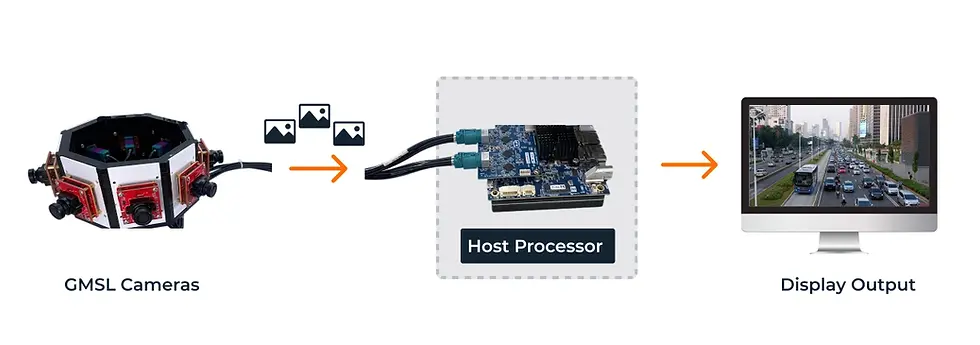
Image Capture: The image sensor captures a frame and outputs raw pixel data in parallel format, typically multiple data lanes running simultaneously.
Serialization: The serializer chip on the camera board takes that parallel data and converts it into a continuous high-speed serial stream. At this point, the data is ready to travel.
Cable Transmission: The serialized data stream travels down a GMSL cable, either a coaxial cable or a shielded twisted-pair cable, to the receiving end. The cable's shielding is what keeps the signal clean in electrically noisy environments like vehicle engine bays, factory floors, or operating theaters.
Deserialization: At the receiving end, the deserializer chip reconstructs the serial stream back into parallel data. Error correction runs here too, catching and correcting any bit errors that crept in during transmission.
Processing: The parallel data is handed off to the host processor, an NVIDIA Jetson, an automotive SoC, or an industrial computer, for whatever the application needs to do with it.
The entire process happens with latency measured in microseconds. For a GMSL1 system, typical latency is under 1 microsecond. That kind of timing precision matters in ADAS systems where a late frame can be a safety issue, and in industrial inspection where you're making pass/fail decisions at high line speeds.
GMSL Camera Cables and Connectors: What You Need to Know
The GMSL cable is not just a passive wire. It's an active part of the signal chain, and choosing the wrong cable type or length will cost you signal integrity.
Coaxial cable is the standard choice for GMSL deployments. The coax structure, a central conductor surrounded by a dielectric and then a braided shield, gives excellent protection against electromagnetic interference. In automotive applications, where the camera is sitting near motors, ignition systems, and high-voltage power lines, that shielding isn't optional. It's the difference between a clean image and a frame full of interference artifacts.
Shielded twisted-pair (STP) cable is the alternative. It's lighter, more flexible, and generally cheaper than coax. For applications where EMI exposure is moderate and cable routing flexibility matters, inside a medical device housing, for example, STP can be the right call.
The GMSL connector on each end needs to match the cable type and maintain the signal integrity that the cable was selected to provide. Coax deployments typically use FAKRA or HSD connectors, which are common in automotive camera systems. Getting the connector choice and termination right is just as important as the cable itself; a poorly terminated connector will introduce reflections that degrade signal quality at the speeds GMSL operates.
Cable length matters too. GMSL2 supports distances up to 15 meters. That's enough to run a camera from the front bumper of a vehicle all the way to a central processing unit in the cabin. For most industrial and medical applications, it's more than adequate.
(GMSL vs GMSL2 vs GMSL3)What Actually Changed
The three generations of GMSL technology are not just incremental bandwidth bumps. Each one addressed real limitations that showed up in deployed systems.
GMSL (GMSL1)
The original GMSL Camera interface was built for automotive video streaming and surveillance applications. It uses coaxial cabling and supports data rates up to 3.125 Gbps. That's enough for 1080p60 uncompressed video with latency under 1 microsecond.
For a lot of legacy automotive camera systems, rear-view cameras, and surround-view systems using standard HD sensors, GMSL1 is still perfectly adequate. The hardware is well understood, the ecosystem is mature, and the cost is lower than that of the newer generations.
GMSL2
GMSL2 doubled the bandwidth, pushing data rates up to 6 Gbps over the same 15-meter coaxial or twisted-pair cable. The jump to 6 Gbps opened the door to 4K video, multi-camera aggregation over a single cable run, and more demanding applications where GMSL1's 3.125 Gbps ceiling was becoming a constraint.
GMSL2 also introduced enhanced data integrity checking, more robust error detection and correction than GMSL1, which matters in environments where the cable runs through electrically hostile territory. It supports bidirectional communication over the same physical medium, which means camera control signals and video data share the cable without needing separate wiring.
For most new embedded vision designs in 2026, GMSL2 is the baseline to start from. It's the sweet spot of capability, ecosystem maturity, and hardware availability.
GMSL3
GMSL3 is the current high-water mark. It supports data rates up to 12 Gbps in the forward channel and 187 Mbps in the reverse channel. That forward bandwidth is enough to carry uncompressed 4K video at 90 fps, smooth, artifact-free, with no compression latency.
The headline capability of GMSL3 is multi-stream aggregation. A single GMSL3 cable can carry three simultaneous 4K streams, which means a single cable run from a multi-camera array back to a central processor. In autonomous vehicle perception systems, where you might have cameras covering every angle of the vehicle, being able to aggregate multiple streams over a single cable is a significant system architecture win.
GMSL3 also enables real-time 3D imaging and surround-view systems that weren't practical with GMSL2. If you're building a next-generation ADAS platform or a high-end industrial machine vision system that needs maximum bandwidth and multi-camera support, GMSL3 is where that conversation starts.
Key Features That Make GMSL Camera the Right Choice
Long-distance transmission without signal degradation. Up to 15 meters of reliable, high-speed video transmission. That's a distance that rules out MIPI and challenges even USB 3.x in terms of signal integrity.
Bidirectional communication on a single cable. Video data travels from the camera to the processor, and control signals travel back, all over the same physical medium. This simplifies cable routing and reduces harness complexity significantly.
Multiple interface compatibility. GMSL Camera works with HDMI, CSI-2, DSI, and eDP. If you're integrating a GMSL camera into a system that uses CSI-2 at the processor end, the deserializer handles the conversion. You don't need to redesign around the interface.
Power over Coax (PoC). GMSL supports delivering power to the camera over the same coaxial cable used for data. In automotive and field-deployed systems, this eliminates a separate power cable run, a cleaner harness, fewer connectors, and less to go wrong.
EMI resistance. Coaxial cabling with proper GMSL connectors provides strong shielding against electromagnetic interference. This is non-negotiable in automotive environments and highly desirable in industrial and medical settings where other equipment generates significant electrical noise.
Where GMSL Cameras Are Actually Used

Automotive and ADAS: This is where GMSL was born. Front cameras, rear cameras, surround-view systems, in-cabin monitoring, anywhere a camera needs to connect to a central domain controller over meaningful cable distance in a high-EMI environment.
Industrial automation and robotics: Factory floors have the same EMI challenges as vehicle engine bays. Long cable runs between cameras on robotic arms and processing units in control cabinets are exactly what GMSL Camera handles well.
Medical imaging: Mobile imaging carts, surgical systems, and diagnostic equipment often need cameras mounted at a distance from the processing unit. GMSL's low latency and signal integrity make it appropriate for applications where image quality directly affects clinical decisions.
Agricultural machinery: Cameras on harvesters and tractors operate in high-vibration, high-EMI environments with long cable runs back to cab-mounted processors. GMSL2 is increasingly the interface of choice for precision agriculture vision systems.
Sports broadcasting and live event production: Multi-camera systems that need reliable high-bandwidth video transmission over distance without the overhead of compression.
Vadzo Imaging's GMSL Camera Portfolio
At Vadzo Imaging, GMSL cameras are not designed just to meet specifications on paper; they are built with real deployment conditions in mind. In many applications, cameras are expected to operate over longer cable distances, in electrically noisy environments, and often under continuous load. That's the context these designs are built for.
The current portfolio includes support for both GMSL2 and GMSL3 interfaces, with different sensor options depending on what the application demands. You can read more about how Vadzo approaches GMSL camera interface design here.
For example, in this scenario involving motion or inconsistent lighting, features like global shutter and HDR become important, so those configurations are available where they make sense. From a mechanical and environmental standpoint, some use cases require additional protection. In such cases, the cameras are offered with IP-rated enclosures to handle exposure to dust, vibration, or outdoor conditions.
If you're working through interface selection for a system that needs long-distance, high-bandwidth, and low-latency camera connectivity, explore Vadzo's GMSL camera interface overview to understand how GMSL compares with other interfaces, or go directly to the online store to browse available configurations. For custom sensor, enclosure, or integration requirements, the Vadzo team is ready to help. Get in touch here.
Closing Note: What to Consider Before Selecting a GMSL Camera
Most interface decisions in embedded vision are straightforward until you push past the boundaries of what USB or MIPI can handle. The moment your camera needs to be more than a meter from your processor, or the moment you're operating in an environment where EMI is a real concern, or the moment your application demands uncompressed 4K with sub-millisecond latency, that's when GMSL Camera stops being a niche option and becomes the obvious answer.
GMSL1 got the industry started. GMSL2 made it practical for a wide range of demanding applications. GMSL3 opened the door to multi-stream 4K and the next generation of perception systems.
Knowing which generation fits your application, which GMSL cable and GMSL connector your deployment environment demands, and which sensor configuration your use case requires, that's where getting GMSL Camera right actually happens.