How Does Dynamic ROI Increase Camera Frame Rates Without Sacrificing Image Quality?


Dynamic ROI is a camera mode that reads only a chosen window of the sensor instead of the whole frame, and lets that window move or resize while the camera streams. Fewer rows are read, so the frame rate rises, and fewer pixels are sent, so bandwidth falls.
This guide explains how it works, separates windowed readout from ROI-based exposure and focus, and shows where it is used on Vadzo’s AR2020, AR1335, and AR0821 cameras, from barcode lines to drone payloads.
What is Dynamic ROI and how does it work?
A sensor is a grid of pixels read out row by row. On a rolling shutter sensor, the time to finish a frame depends on how many rows are scanned. The camera sets a start row, a start column, a width, and a height, and reads only that window. Readout time shrinks with the window, so the frame rate goes up.
Frame time is roughly the number of rows times the time to read one row, plus a fixed gap between frames. A window of 1080 rows out of 3840 reads about 28 percent of the rows, so the row-scan part of the frame time falls to about that share.
This differs from a digital crop or from downsampling. Both read every row first and discard pixels afterward, so the frame rate stays tied to full-frame readout. A true window skips the rows outside it.
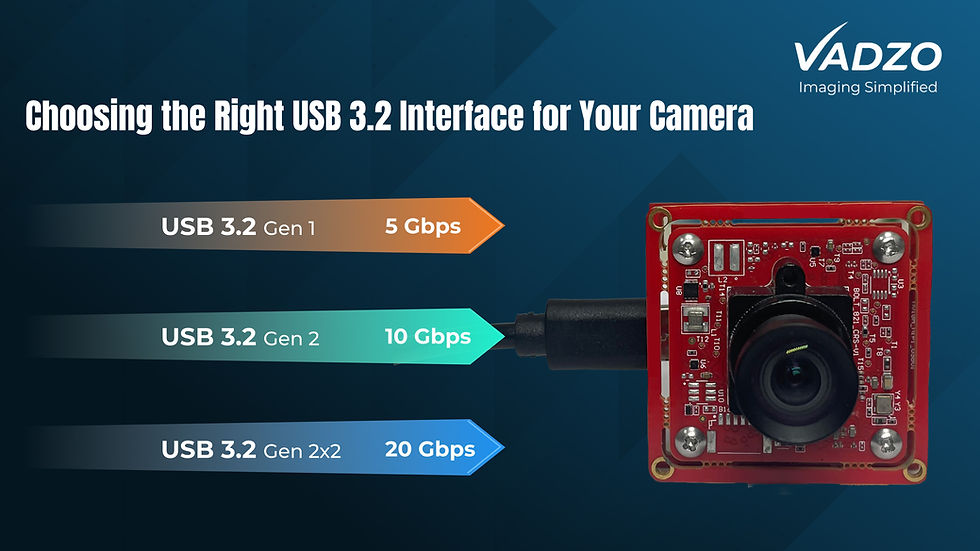
Bandwidth shows the effect. A full AR2020 frame is 5120 x 3840 pixels, about 157 megabits at 8 bits per pixel. A 1920 x 1080 window is about 16.6 megabits, roughly nine times less data. With USB 3.2 Gen 1 at a nominal 5 Gbps, the interface ceiling is near 30 frames per second for the full frame and near 300 for the window. Real rates also depend on sensor readout, exposure time, and the host.
Dynamic means the window can change during streaming. On the Falcon-2020CRS, Vadzo configures the sensor’s windowed readout registers through USB vendor commands, so an application can reposition and resize the window as a tracked object moves. A high dynamic ROI camera in this sense is one whose window follows the subject without stopping the stream.
Windowing or exposure and focus: which region of interest do you need?
The term covers two jobs. Windowing chooses which pixels are read, which changes frame rate and bandwidth. ROI-based auto exposure (AE) and autofocus (AF) choose where the camera measures brightness and sharpness, and the readout stays the same.
A camera that meters the whole frame serves the average of the scene, and the average is rarely the subject. A bright kiosk screen, a sunlit window, or a specimen on a dark stage can pull exposure and focus away from the subject. With ROI-based AE and AF, the camera measures inside a region the integrator choose.
A Region of Interest Camera can apply the region to either job, and a Dynamic Region of Interest setup lets the region move with the subject. The Falcon-1335CRA lists ROI-based AE and AF, and Vadzo has validated windowed streaming on the Falcon-2020CRS and Falcon-821CRH. Digital PTZ on the Falcon-1335CRA pans, tilts, and zooms inside the frame without moving parts.
Which Vadzo cameras work as a Dynamic ROI embedded camera?
The three cameras below cover the AR2020, AR1335, and AR0821 sensors. All three are rolling shutter color cameras with a USB 3.2 Gen 1 interface and UVC support. Vadzo’s Dynamic ROI camera modules page lists the full range across the Vajra, Falcon, and Bolt series.
Falcon-2020CRS: 20MP AR2020
The Falcon-2020CRS pairs the onsemi AR2020 (1/1.8-inch, 1.4 µm pixels, 5120 x 3840) with windowed readout that Vadzo has validated. Besides a window at any position and size, it keeps full 20MP, 4K, 1080p, 720p, and VGA modes, so one high dynamic ROI camera can capture a full-resolution frame and then window down to a fast region. It enumerates as a UVC device on Windows, Linux, and Android with no proprietary driver. The product page also lists Smart ROI dual-stream output for optimized bandwidth.
Falcon-1335CRA: 13MP AR1335
The Falcon-1335CRA is built on the onsemi AR1335 (1/3.2-inch, 1.1 µm pixels, 4208 x 3120) with VCM autofocus from 100 mm to infinity. Its ISP supports ROI-based AE and AF, Digital PTZ, and iHDR, and it comes in 74 and 127 DFOV variants. It weighs 13 g without lens and is USB powered.
Falcon-821CRH: 8MP AR0821 HDR
The Falcon-821CRH uses the onsemi AR0821 (1/1.7-inch, 2.1 µm pixels, 3848 x 2168) with VCM autofocus and embedded HDR above 140 dB, according to Vadzo. It outputs 4K at 30 fps over USB 3.2 Gen 1, weighs 20 g without lens, and operates from -30 to 70 °C. Vadzo has validated windowed streaming that works together with the autofocus, so focus holds as the window changes.
Where is windowed ROI used, from barcode lines to drones?
Dynamic ROI suits any job where the subject fills only part of the frame. Each example below pairs a wide view for context with a window for detail.
Barcode reading. On a parcel line, labels pass through a small part of the view. Vadzo’s Dexter-1000-GigE, an AR2020 barcode camera, lists a real-time ROI window, so the camera concentrates on the label area while it decodes codes on board.
Facial recognition. At a kiosk or access point, a bright screen or a sunlit window can pull exposure away from the person. ROI-based AE and AF on the Falcon-1335CRA meter and focus inside a region placed on the face, so the face stays evenly exposed and sharp for the recognition software.
Payloads and UAVs. A payload can send a wide view at a low rate and then window down on one target, such as a power line insulator, at full detail. Vadzo’s drone and UAV page lists AR2020 modules, and the Falcon-821CRH release names UAVs. Windowing keeps the data link and the onboard processor from handling full frames at every step.
Photogrammetry. A mapping pass needs full frames with overlap. With a 6 mm lens at 60 m, the AR2020’s 1.4 µm pixels give 14 mm of ground per pixel, and a 1920 x 1080 window covers about 27 m x 15 m. A small window can then re-center on a ground marker at a high rate between full-frame captures.
Drone monitoring. A wide view finds a moving vehicle along a perimeter fence, then the window follows it. Vadzo’s drone page lists surveillance drones for border patrol, perimeter security, and public safety, which is where a small, fast window helps.
Drone field point. At a surveyed field point, such as a ground control marker, the drone hovers while the camera windows down on the marker. The marker is read at full detail, and little data leaves the camera.
Agriculture. Vadzo’s drone page names agriculture among the mapping and surveying users. A full-frame pass builds the field map, and a window at full detail checks one plot or row at a time.
How do you set up ROI windowing?
Pick the window from the smallest feature and the frame rate you need. Fewer rows mean faster readout.
Check the link. A window’s data per frame is its width x height x bits per pixel, and the interface must carry it at the target rate. For a 1920 x 1080 window at 8 bits per pixel and 120 frames per second, that is about 2 Gbps.
Plan the control path. The Falcon-2020CRS takes USB commands, and Vadzo’s VISPA ARC SDK provides ROI configuration for its USB cameras on Windows, Linux.
Decide where exposure is metered. Use ROI-based AE and AF when a bright background pulls the picture away from the subject.
Watch rolling shutter skew. Skew grows with readout time, so a smaller window also shortens it: at 10 m/s, each millisecond of readout shifts the scene by 10 mm.
Evaluate on the bench. Vadzo’s evaluation kit for the Falcon-2020CRS includes the camera, a USB 3.2 Gen 1 cable, an S-mount lens, and documentation for full-frame and windowed configuration, and evaluation units have no minimum order.
Test the whole chain at the planned window size. Vadzo’s validation on the Falcon-2020CRS covers window placement accuracy, exposure and gain consistency across repositioned windows, and frame timing stability across window sizes.
Key takeaways
Windowed readout reads only a chosen part of the sensor, so frame rate rises and data falls.
A window skips rows, unlike a digital crop or downsampling, which read the full frame first.
A full 20MP frame is about 157 megabits; a 1920 x 1080 window is about 16.6 megabits.
ROI-based AE and AF meter and focus inside a chosen region, as on the Falcon-1335CRA.
Vadzo has validated windowed streaming on the Falcon-2020CRS (AR2020) and Falcon-821CRH (AR0821).
Frequently Asked Questions
What is a region of interest camera, and how does it work?
A Dynamic ROI camera reads a chosen window of the sensor instead of the full frame. The sensor scans only the rows inside the window, so each frame finishes sooner and the frame rate rises, while fewer pixels cross the interface. The window can be repositioned and resized during streaming, so it can follow a moving subject.
How does windowed readout differ from cropping or downsampling?
A digital crop or downsample reads every row first and removes pixels afterward, so the frame rate stays tied to full-frame readout. Windowed readout skips the rows outside the window, so the readout time shrinks with the window size. That is why a small window can stream at a much higher rate than the full sensor.
Which Vadzo cameras suit ROI windowing in industrial automation?
The Falcon-2020CRS (AR2020, 20MP) and Falcon-821CRH (AR0821, 4K HDR) have validated windowed streaming over USB 3.2 Gen 1. Each can capture a full frame for setup and then window down to a fast region on a line. As a Dynamic ROI embedded camera, either one lets a single module do both jobs.
Which Vadzo camera has validated windowed streaming on the AR2020?
The Falcon-2020CRS. Vadzo validated a windowed mode that sets the sensor’s readout registers through USB vendor commands, so the window can be repositioned and resized live. The camera keeps its full 20MP, 4K, 1080p, 720p, and VGA modes and streams over USB 3.2 Gen 1 as a UVC device.
How does ROI-based exposure and focus work on the AR1335 cameras?
On the Falcon-1335CRA, the ISP measures exposure and finds focus inside a region the integrator chooses, instead of using the whole frame. A bright screen or window elsewhere in the view then has less pull on the subject. The camera also offers VCM autofocus from 100 mm to infinity, Digital PTZ, and iHDR.
Which Vadzo cameras suit drone and UAV payloads?
Vadzo’s drone and UAV page lists AR2020 modules in color and monochrome on MIPI CSI-2 and USB 3.2 Gen 1. The Falcon-821CRH release also names UAVs, and the Falcon-2020CRS weighs 18 g without lens. Windowed streaming lets a payload keep full frames for mapping and a small window for fast tracking.
Can ROI windowing help photogrammetry and agriculture flights?
Yes, as a complement to full-frame capture. Mapping passes need full frames with overlap, and a window can be used between them to re-center on a marker or check one plot at full detail. With a 6 mm lens at 60 m, the AR2020 gives 14 mm of ground per pixel.
How is ROI controlled on USB and MIPI cameras?
On Vadzo’s USB cameras, the Falcon-2020CRS can be controlled through UVC, and the VISPA ARC SDK provides ROI configuration for Windows, Linux. MIPI CSI-2 cameras such as the Bolt series connect directly to the host processor and Control through V4L2 commands.
Why choose Vadzo Imaging for an OEM camera project?
Vadzo Imaging develops OEM embedded camera solutions, and its pages list customization such as board redesigns, firmware changes, NIR and color LED array boards, ToF, mmWave radar, and IMU integration, lens holder changes, and IP-rated or non-IP-rated enclosures. Samples typically ship within 5 to 7 business days of order confirmation.