USB 3.2 Gen 1, Gen 2, and USB 3.2 Gen 2x2 - What's the distinction when it comes to USB Camera Performance?

Updated: 3 days ago
USB interfaces have seen significant development over the years, and with each new version, the naming conventions and claims of performance have become increasingly difficult to track. Camera makers and system integrators face a simple question: what do these USB generations really signify, especially when trying to understand USB 3.2 Gen 1 vs Gen 2, and how does USB 3.2 Gen 2x2 relate to today's USB camera design?
This article clarifies USB 3.2 generations in a simple and practical manner, particularly focusing on USB cameras and how higher, bandwidth interfaces like USB 3.2 gen 2x2 are opening new possibilities in ultra-fast imaging applications.
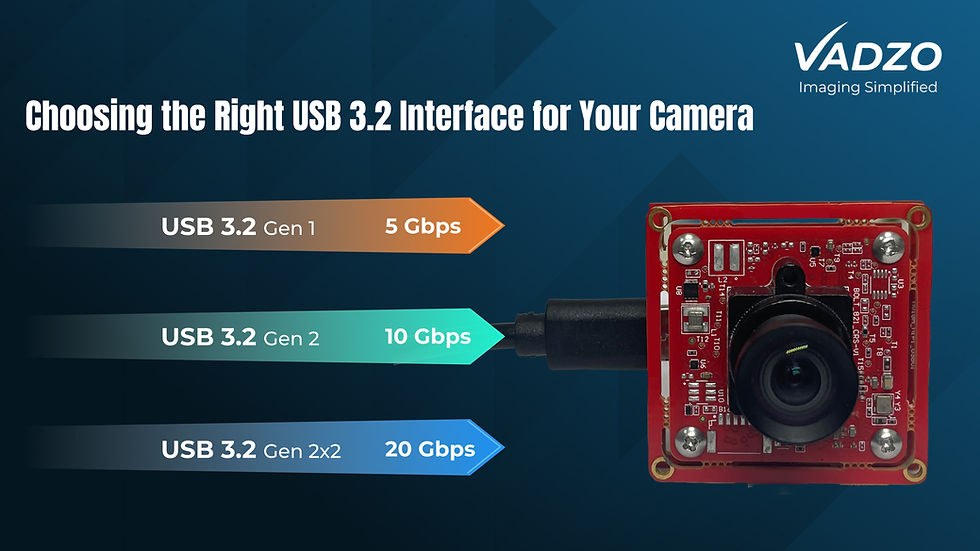
From USB 3.0 to USB 3.2 Gen 2x2: Clearing the confusion
USB 3.0 was a landmark update to USB 2.0 that was released in 2008. It significantly improved the data transfer rate from 480 Mbps to 5 Gbps. After some time, USB standards were renamed to make things easier for backward compatibility and standardization.
So, the USB 3.0 standard has been renamed USB 3.2 Gen 1. Technically, they are the same standard, both supporting a bandwidth of up to 5 Gbps. USB 3.2 Gen 1 is still a pretty common standard for many USB cameras nowadays, and it is enough to handle moderate resolution and frame rate. But, as cameras get better, the limitations of Gen 1 are becoming quite clear, especially when you look at USB 3.2 Gen 1 vs Gen 2 for high-performance cameras.
Why USB naming was changed
The USB Implementers Forum (USB, IF), which is the group that keeps USB standards, has introduced new naming conventions to make sure that all the devices, cables, and host systems are consistent. It was aimed at supporting backward compatibility while allowing higher performance levels to be unified under a single specification.
Renaming caused some short, term confusion, but it enables different generations, Gen 1, Gen 2, and USB 3.2 gen 2x2, to be part of the same USB ecosystem.
USB 3.2 Gen 1 vs Gen 2: What actually changes?
The difference between USB 3.2 Gen 1 vs Gen 2 lies mainly in their speed.
USB 3.2 Gen 1: up to 5 Gbps
USB 3.2 Gen 2: up to 10 Gbps
There aren't any significant changes to protocol basics or compatibility. USB 3.2 Gen 2 doubles the bandwidth available. This, in the case of USB camera applications, directly affects:
Maximum attainable resolution
Frame rates less dependency on compression
Streaming of real-time video is more stable
When camera developers compare USB 3.2 Gen 1 vs Gen 2, they find that Gen 2 starts to eliminate a lot of the issues that higher, resolution sensors and faster frame rates pose.
The Arrival of USB 3.2 Gen 2x2
With the launch of USB 3.2 gen 2x2, USB technology moved on where that version of the standard doubled the bandwidth again by using two 10 Gbps lanes simultaneously. Therefore, it is possible to have 20 Gbps of total throughput.
USB 3.2 gen 2x2 is a major upgrade for USB in general, and it certainly changed the game for data, hungry devices such as cameras. Only over USB, C is this standard supported which also enables enhanced data rates and power delivery.
The USB 3.2 gen 2x2 specification allows the USB camera manufacturers to be as innovative as they want to be in the following ways:
Uncompressed or hardly compressed high-resolution video streaming
Superior frame rates without dropped frames
Minimized latency for real, time vision systems
Significantly lower CPU load on the host system
USB 3.2 gen 2x2 offers bandwidth quantities that are usually connected with Camera Link or CoaXPress interfaces, which makes it a big leap in the field of USB-based imaging.
A quick comparison of USB 3.2 generations
USB Specification | Also Known As | Max Bandwidth | Common Connector |
USB 3.2 Gen 1 | USB 3.0 | 5 Gbps | USB-A, USB-C |
USB 3.2 Gen 2 | USB 3.1 Gen 2 | 10 Gbps | USB-A, USB-C |
USB 3.2 Gen 2×2 | USB 3.2 | 20 Gbps | USB-C |
This table shows why usb 3.2 gen 2x2 is the best option for future USB cameras.
Looking Ahead: USB4 and beyond
USB technology keeps changing and improving. USB4, for instance, can support data transfer speeds up to 40 Gbps and is more compatible with Thunderbolt. USB4 cameras are not yet widely available, but this upgrade shows how different industries are moving towards high bandwidth systems and simplified architectures.
Until USB4 is widely used, USB 3.2 Gen 2x2 can be seen as a practical solution that connects traditional USB cameras to future highly efficient vision systems.
Picking the correct USB interface for your camera
Although debates like USB 3.2 Gen 1 vs Gen 2 are still valid nowadays, new imaging technologies are gradually exceeding these standards. As camera sensors aim for higher resolutions and increased frame rates, the choice of an interface will be very important.
This is where Vadzo Imaging's Vajra USB camera family (USB 3.2 gen 2x2 based camera), are meant to handle the increased bandwidth requirements of the future while at the same time avoiding complexities in user experience and offering the great flexibility USB cameras are typically known for.
Final Thoughts
When you first look at the USB standards, they may be complicated, but if you separate them based on capability and application, the differences become obvious. Having a clear understanding of USB 3.2 Gen 1 vs Gen 2 and the benefits of USB 3.2 gen 2x2 allows camera manufacturers to make the right decisions about interfaces not only based on the current camera requirements but also considering the future scalability as imaging performance keeps improving.


