Power Over Ethernet Camera Systems for Industrial Surveillance: Architecture, Benefits, and Deployment Reality

Updated: 2 hours ago
Industrial surveillance has evolved significantly. What was once a simple perimeter surveillance task has grown into a sophisticated system that enables safety, process monitoring, quality assurance, and regulatory compliance. In such environments, camera failures are no longer a concern of image quality; they are more likely to be the result of unstable power, network problems, or poorly designed systems.
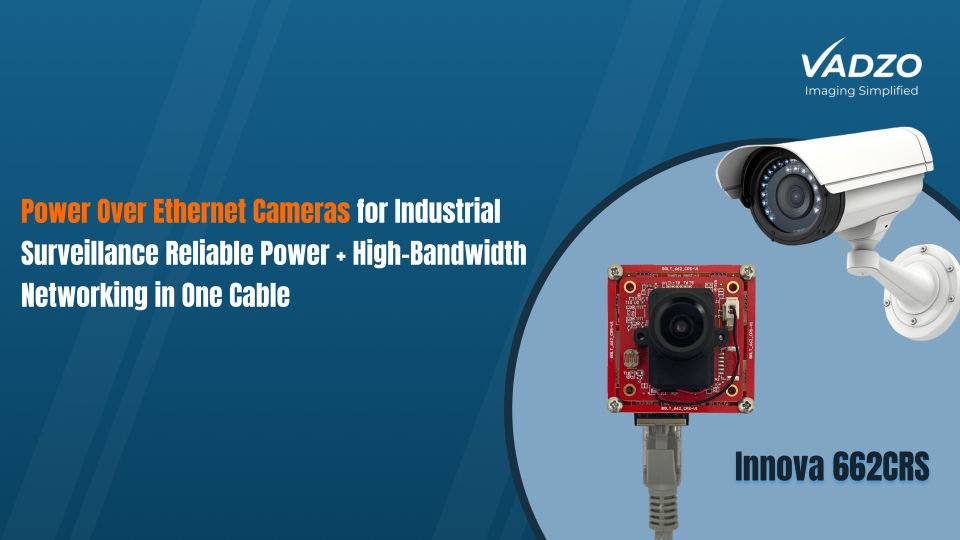
This is where a Power Over Ethernet camera can help. With the ability to transmit both power and data through a single Ethernet cable, PoE cameras make installation easier, more centralized, and more reliable in industrial environments.
Why Power over Ethernet Cameras Are Important in Industrial Environments
Industrial environments are not tolerant of failures. However, the presence of constant vibration, temperature variation, electromagnetic interference, and continuous operation makes conventional IT cameras unsuitable. Local adapters with traditional cameras also add multiple points of failure, such as loose connections, unstable voltage, and power sources difficult to access. PoE cameras solve these issues by combining power and networking features. Through centralized management via industrial-grade switches, the system downtime is at a minimum, and problem-solving is made easy, so your system is running without interruption.
How Power over Ethernet Cameras Function
PoE cameras usually adhere to standards such as 802.3af, 802.3at (PoE+), or 802.3bt (PoE++). Which allows the power and data to be sent over one Ethernet cable. This has several important advantages:
Reduced number of cables and connections
Centralized monitoring and control
Quick and easy installation
Enhanced low-voltage safety
Once installed, PoE cameras can be a part of a managed network used without interruption, where high availability, scalability, and maintainability are most essential.
PoE Camera Benefits for Industrial Surveillance Cameras
The most important PoE camera benefits extend far beyond installation convenience. In industrial surveillance cameras, they directly influence operational continuity, safety, and total cost of ownership.
Simple Installation: One cable accomplishes two tasks; the installation is not only quick but also does not require complicated electrical wiring. It is just right for ceiling mounting, outdoor, or mobile applications.
Centralized Power Management: Engineers can monitor, reboot, or remotely shut down the cameras, which helps them to carry out less manual maintenance and repairs, thus reducing downtime.
Reliable Performance: Industrial-grade Ethernet connectors can withstand excessive vibrations and heat more than any other type and are considerably stronger.
Predictable Coverage: Power over Ethernet camera allows for cable lengths of up to 100 meters, thus facilitating the coverage of large buildings uniformly.
Lower Risk: Operating at low voltage (~48V) decreases the potential of electric shock during installation or maintenance.
Cost Savings: The use of fewer parts, more rapid diagnosis of faults, and less time required to get things running again all contribute to significantly lower costs over time.
Power Over Ethernet Camera Architecture for Industrial Surveillance Cameras
High-bandwidth content, such as Full HD, 4K, or high frame rate video, requires the use of industrial cameras that are capable of such resolution. PoE+ or PoE++ can supply advanced sensors and onboard processing, whereas UPS, backed switches can provide the power during outages. Proper NVRs, VMS, and analytics integration will help ensure constant surveillance.
Engineers need to consider:
Evaluate the total power consumption per switch, especially with cameras that consume a lot of power
Check the quality of the cable, grounding, and shielding when the environment is noisy
Implement redundancy mechanisms, such as UPS or ring networks, for uninterrupted service
If done right, PoE systems can be scaled up effortlessly and in a very predictable manner, even under heavily industrialized environments.
Industrial Use Cases for Power over Ethernet Camera
Factory Safety and Surveillance
PoE cameras provide a steady video feed for robot cells and other inaccessible areas without a local power supply installation.
Warehouses and Distribution Services
PoE facilitates the deployment of security cameras anywhere due to the availability of Ethernet, ensuring the coverage of aisles, docks, and transfer areas.
Production Line Quality Control
Inspection cameras as PoE nodes offer stable, low-latency video for accurate monitoring.
Outdoor and Perimeter Surveillance
Combined with reduced installation efforts and dependable working conditions, PoE is suitable for yards, loading zones, and secluded facilities.
Power Over Ethernet Camera vs Traditional Network Cameras
For the case of industrial operations, long-term dependability is more crucial than the original cost of the equipment.
Feature | Power over Ethernet Camera | Traditional Camera |
Cabling | Ethernet only | Separate power & data |
Resilience | UPS-backed centralized power | Local adapters only |
Maintenance | Remote power cycling | Manual access needed |
Scalability | Easy addition | Requires electrical rework |
PoE systems have invariably led to more uptime, easier maintenance, and lower operational risk.
Vadzo Imaging’s Approach to Power Over Ethernet Camera Design
At Vadzo Imaging, PoE cameras are engineered as core elements of the industrial imaging ecosystem, combining industrial-grade hardware with standardized GigE networking. Our cameras integrate high-performance Sony sensors, optimized onboard image processing, and are qualified for stable operation across extended temperature ranges.
The Innova 662CRS, based on the Sony Starvis IMX662 (1/2.8″, 2.9 µm x 2.9 µm) sensor, delivers 1080p resolution optimized for ultra-low-light monitoring with integrated IR-cut control. The Innova 900MGS, built on the Sony IMX900 Pregius S (1/3.1", 2.25 µm x 2.25 µm) global shutter sensor, provides distortion-free image capture for high-speed imaging with high dynamic range. Both cameras operate over PoE-enabled GigE (IEEE 802.3af), support ONVIF standards, and integrate using Vadzo NXT SDK across Windows, Linux, and Android, enabling low-light, high-speed, and global shutter imaging within a unified network architecture.
The Strategic Role of Power Over Ethernet Camera Systems
Power over Ethernet camera is an essential component of the security system that can match the level of industrial facilities, integrating automation, AI analytics, and connected operations. In fact, their reliability, scalability, and user friendliness meet the different needs of engineers, system integrators, and executives, respectively.
Regarding future surveillance systems, not having PoE is similar to a choice that compromises long-term performance and operational confidence. Before you expand, review your network and power configuration and consider committing to a Power over Ethernet camera from Vadzo Imaging for installations that will last.
If you’re evaluating PoE-based surveillance for your next deployment, connect with Vadzo Imaging. Our engineering team can help you choose the right PoE camera architecture, streamline integration, and build a system designed for long-term industrial reliability.


