10 AI Applications Examples Using Embedded Cameras in 2026

Your drone loses GPS thirty meters into a tree line. Your AMR reads a floor marker at full speed and the frame comes back smeared. A care-room camera has to work with the lights off and still tell a nurse that a patient is climbing out of bed.
These ten AI applications examples across embedded vision fail the same way. The camera module sets the limit in each case. Shutter type, interface bandwidth, illumination, and where inference runs decide whether the system works in the field or only on a bench.
None of it is theoretical. Specs come from datasheets. Failures show up in commissioning. Those trade-offs decide whether a proof of concept survives its first winter outdoors.
Table of Contents
1. Drone Visual Obstacle Avoidance and Navigation - Where visual navigation fails
2. AMR and AGV Navigation and Obstacle Detection - The blur budget
4. Fixed-Mount Barcode and QR Code Reading at Kiosks and Point of Sale - Optics before algorithms
7. Smart Parking Occupancy Detection and License Plate Recognition
8. Precision Agriculture Weed and Crop Detection for Smart Spraying - What the camera has to survive
10. Drone-Based Infrastructure and Crop Inspection with Onboard AI
11. How the Camera Choices Differ Across the 10 Embedded Vision Applications
1. Drone Visual Obstacle Avoidance and Navigation
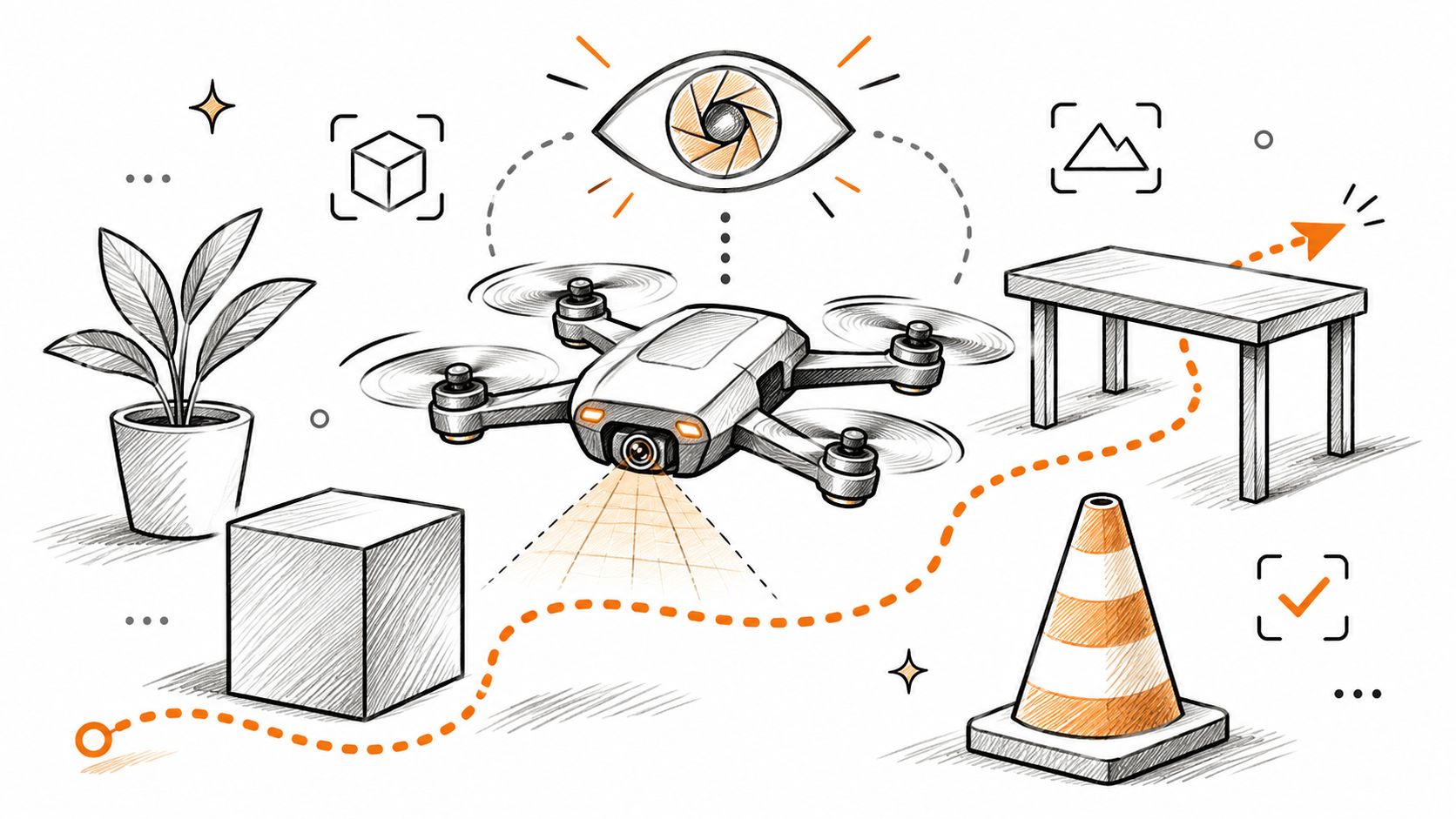
A UAV under a canopy or inside a tunnel has no reliable absolute position and no time for a cloud round trip. Forward- and downward-facing cameras feed an onboard network that builds a depth or occupancy map, estimates motion, and steers around hazards. Skydio's drones run this kind of autonomy on NVIDIA Jetson hardware, doing obstacle avoidance and subject tracking on the aircraft itself. Research and inspection airframes use the same idea for visual-inertial odometry in mines and tunnels, where the camera is the only sensor that keeps working.
The camera decision here is mostly about shutter and synchronization.
Where visual navigation fails
Low texture, direct sun into the lens, prop vibration, and dim light all degrade the depth estimate before the network ever sees a frame. Motion blur is the usual culprit at low light, because the exposure stretches and the airframe keeps moving. Fix the lighting or the shutter, not the model.
Global shutter on any airframe that pitches or yaws. A rolling shutter reads rows sequentially, so a fast yaw skews every frame and your odometry drifts with it.
Damp the mount and check the vibration spectrum. Flight logs will show you the resonance peaks; a rigid bracket passes them straight into the image.
Confirm driver support before you commit to a sensor. Vadzo's MIPI range lists drivers for Jetson Orin Nano, Orin NX, and AGX Orin, plus Raspberry Pi 4 and 5.
Calibrate intrinsics and camera-to-IMU extrinsics together. Calibrating them separately is the most common source of slow drift in a system that otherwise looks fine.
Spec check: If the airframe moves more than a pixel during your longest exposure, the frame is already lost.
The pipeline details, latency budgets included, are covered in how a low-latency camera improves autonomous drone navigation and object tracking.
2. AMR and AGV Navigation and Obstacle Detection
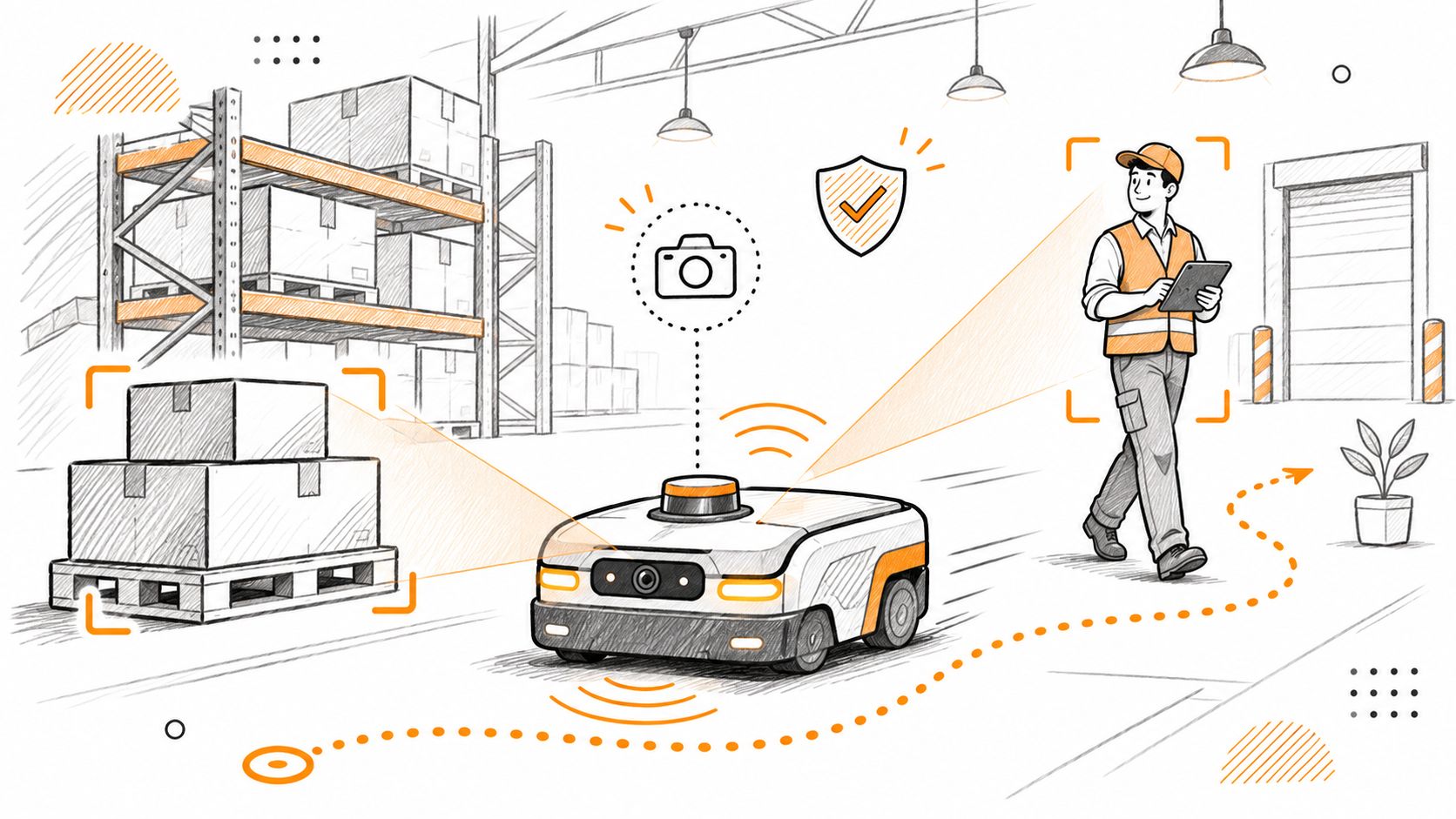
Warehouse floors change weekly. Tape gets pulled up, pallets get staged in new lanes, and people walk the same aisles as the vehicles. Cameras absorb that churn better than fixed infrastructure: a global shutter sensor feeds a pipeline that fuses visual features with wheel odometry and lidar, tracks fiducials for docking, and watches the forward path for people and pallets. Amazon Robotics runs mobile drive units that depend on onboard sensing for navigation, and factory AGV fleets use vision-based fiducial tracking to dock at conveyors and pick stations.
Hardware is where these projects stall. UK government research on AI adoption found that 27% of businesses report significant barriers implementing computer vision or image-processing AI, while 31% report significant barriers related to AI hardware (AI adoption research). On a robot, that barrier looks concrete: an interface the host board can't drive, a sensor that can't hit frame rate, a thermal envelope that fails inside a sealed chassis.
The blur budget
Size the shutter to top speed and closest working distance. Measure edge spread on the floor marker at maximum velocity, not at creep speed.
Light the dark aisles. NIR or white LED illumination keeps exposure short during night shifts without blinding nearby workers.
Restrict processing to the path ahead. A dynamic region of interest on the floor and forward arc cuts compute and reduces false detections from shelving.
Log frames during commissioning. Mixed lighting between skylights and sodium lamps is easier to tune from real captures than from a datasheet.
Motion blur is a measurement, not an opinion. Capture frames at top speed, measure the edge spread, and decide from that number.
3. Kiosk Audience Analytics for Digital Signage
At 3 p.m. the screen beside the escalator is still running the same loop. The useful question is whether anyone stopped. A camera on the kiosk housing, with the model on the same board, counts people in frame, estimates dwell, and flags broad attention. Frames are processed and discarded. What leaves the device is a count and a timestamp.
Dwell is a slow measurement, so the frame rate can stay modest. Someone who pauses is still there on the next frame a moment later. Driving the sensor hard only spends bandwidth and heat inside a sealed enclosure, and the count does not get better. Put that budget into exposure and dynamic range.
Wide dynamic range is the fix when the panel backlight fights a bright atrium. Without it the sensor clips either the faces or the display, and the detector starts missing people or counting the same one twice. Set the field of view before you touch model thresholds. A field-of-view calculator shows whether two shoppers at the far edge land on separate pixels, which is cheaper than a remount. Then compare the counts with manual tallies at several times of day, including the quiet stretch, not only the rush when every model looks accurate.
A privacy review moves faster when nothing is kept. Run inference on the device, leave raw frames off storage, and log the aggregate.
If those counts feed a retail media network rather than a signage loop, the skills mix changes (hiring engineers for retail AI deployments).
4. Fixed-Mount Barcode and QR Code Reading at Kiosks and Point of Sale
A kiosk that reads codes has one advantage over a handheld scanner: the geometry never changes. A fixed-mount GigE camera at a known working distance decodes 1D and 2D codes at odd angles, on creased tickets, on dimmed phone screens, and at the pace a queue moves. Self-checkout lanes read loyalty and mobile payment codes this way, and event gates read QR codes off phones held at whatever angle the holder picks.
Optics before algorithms
Match focal length and sensor resolution to the smallest code module at the actual working distance. Resolution you don't need costs frame rate and bandwidth.
Control the light. LED illumination plus a polarizing filter kills most screen glare, which is what defeats software decoders on phone displays.
Choose GigE for long cable runs or multi-camera networks. It reaches further than USB without hubs, and it survives the electrical noise of a checkout lane.
Test the worst code you expect, not a pristine label printed in the office.
Vadzo's AR2020 AI-Powered 20MP Fixed-Mount Barcode & QR Code GigE Camera is a 20MP fixed-mount option for this class of installation. The broader trade-offs in decoder design and code symbology are covered in how fixed-mount barcode and UPC reading works.
5. Point-of-Care Patient Monitoring and Fall Detection
Bed exits and unassisted falls happen between rounds, which is exactly when nobody is watching. Cameras with an on-device pose model close that gap without sending identifiable video anywhere. The model tracks body position, flags a bed exit or a fall, and pushes an event to the nursing station.
The evidence base is real. A hospital video-monitoring study drawing on 11 hospital partners, more than 300 high-risk fall patients, and over 1,000 inference days reported a macro F1 of 0.92 for object detection and 0.98 for patient-role classification, with the patient-alone trend metric at a mean logistic-regression accuracy of 0.82 ± 0.15 (the hospital monitoring study). Those cameras sat on mobile carts, so angle, distance, and perspective varied room to room. That detail matters more than the headline score.
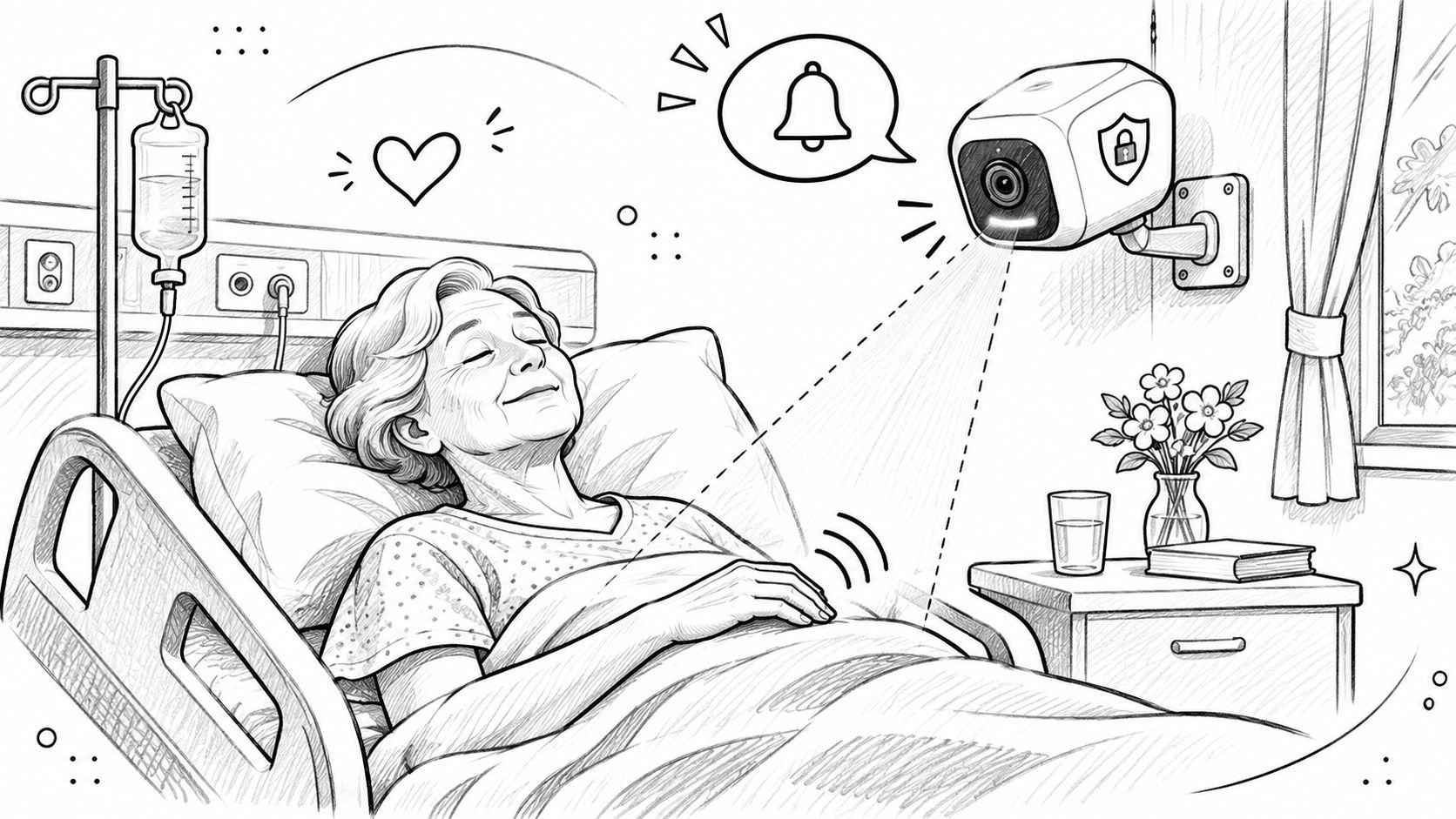
Use NIR-capable cameras with IR illumination so the room stays dark and the patient keeps sleeping.
Transmit events, not video. A pose skeleton plus a timestamp is enough for an alert and keeps you out of most privacy arguments.
Mount to clear bed rails and overhead equipment. Occlusion is the top cause of missed detections in real rooms.
Plan for day and night in one unit. Vadzo's NIR and electromechanical IR cut switchable camera options exist for exactly this split.
Design rule: A monitoring system that works only from a fixed tripod position will fail on a cart. Validate across the angles your staff actually use.
Wider context on how these deployments fit into care workflows is at remote health tech insights from Arch.
6. Medical Imaging for Lab and Point-of-Care Diagnostics
An embedded camera inside a microscope, a lateral-flow reader, or a benchtop analyzer turns a physical sample into pixels a model can grade. Cell counts, color changes on a test strip, confluency, morphology: all of it depends on the sensor delivering consistent color and enough detail, and on RAW Bayer output when the model was trained on unprocessed data.
The regulatory weight here is real but easy to overstate. The FDA authorized 6 AI-enabled medical devices in 2015 and 223 in 2023, an increase of more than 37 times in eight years, with the first such authorization dating to 1995, according to Stanford's AI Index. Authorization covers a range of device functions and regulatory pathways, so treat it as a design constraint, not a reason to avoid the application. The hardware decisions matter first.
Start from RAW Bayer if your model was trained on raw sensor data. Converting to processed RGB mid-pipeline changes the statistics your model learned.
Lock white balance and exposure. Auto modes drift with sample density and illumination, and a lateral-flow reader graded against a shifting white point will grade the same strip differently at nine in the morning and five in the evening.
Match bit depth to the signal. Subtle color transitions on a test strip saturate in an 8-bit pipeline. Higher bit depth preserves the gradations the model uses to separate positive from borderline.
Place reference targets in the frame and recalibrate on a schedule. LEDs age, and so do the assumptions behind a threshold.
Set magnification and coverage with a field-of-view calculator so the sample fits without edge cropping.
Open the regulatory conversation early when output supports a clinical decision. The camera choice becomes part of the submission.
For a lateral-flow reader, the practical test is repeatability across units: run the same reference strip on ten devices and compare the reported values before you trust a single one. If unit four reads consistently darker, look at its illumination and white balance calibration before you suspect the model. Vadzo's High-Fidelity Imaging cameras for clinical systems are USB camera platforms built for exactly this class of integration, covering diagnostic imaging, patient monitoring and laboratory automation with standardized USB output.
7. Smart Parking Occupancy Detection and License Plate Recognition
A parking operator wants two things from one camera: which bays are free, and which plate belongs to the car in the bay. Edge AI handles both when the optics and the lighting are right. Occupancy detection needs coverage and stable geometry. Plate reading needs a shallow angle and enough light at two in the morning.
The accuracy bar is documented. Tennessee's SmartPark pilot set a requirement of better than 95% accuracy for parking-area occupancy counts and reported 99.86% for the OH-OH configuration, 98.94% for CUR-OH, and 99.80% for SID-SID, with error rates of 0.14%, 1.06%, and 0.20% respectively (TDOT's SmartPark final report). The spread across configurations is the lesson: the installed sensing setup, not the camera module alone, decides the result. That report also compared system counts against manual counts from still images, a verification step most pilots skip.
Transportation agencies push the same architecture further. A U.S. Department of Transportation intersection-analytics demonstration combined YOLOv8 detection, BoT-SORT tracking, and a transformer-based trajectory classifier to derive turning-movement counts from raw video, reaching 96% movement-classification accuracy and synchronizing results with signal timing (the USDOT demonstration report). For an integrator, that argues for exporting structured metadata such as trajectories, occupancy events, and counts rather than only encoded video.
Use an IR cut switchable camera or NIR illumination so night plate reads don't depend on visible light.
Pick wide dynamic range sensors for entries where headlights point into the lens.
Mount at a shallow angle to the plate and keep the geometry consistent across bays.
Limit plate retention to whatever your jurisdiction requires, and document the policy.
Capture-side design for plate reading is covered in how an ALPR camera works, from architecture to applications.
8. Precision Agriculture Weed and Crop Detection for Smart Spraying
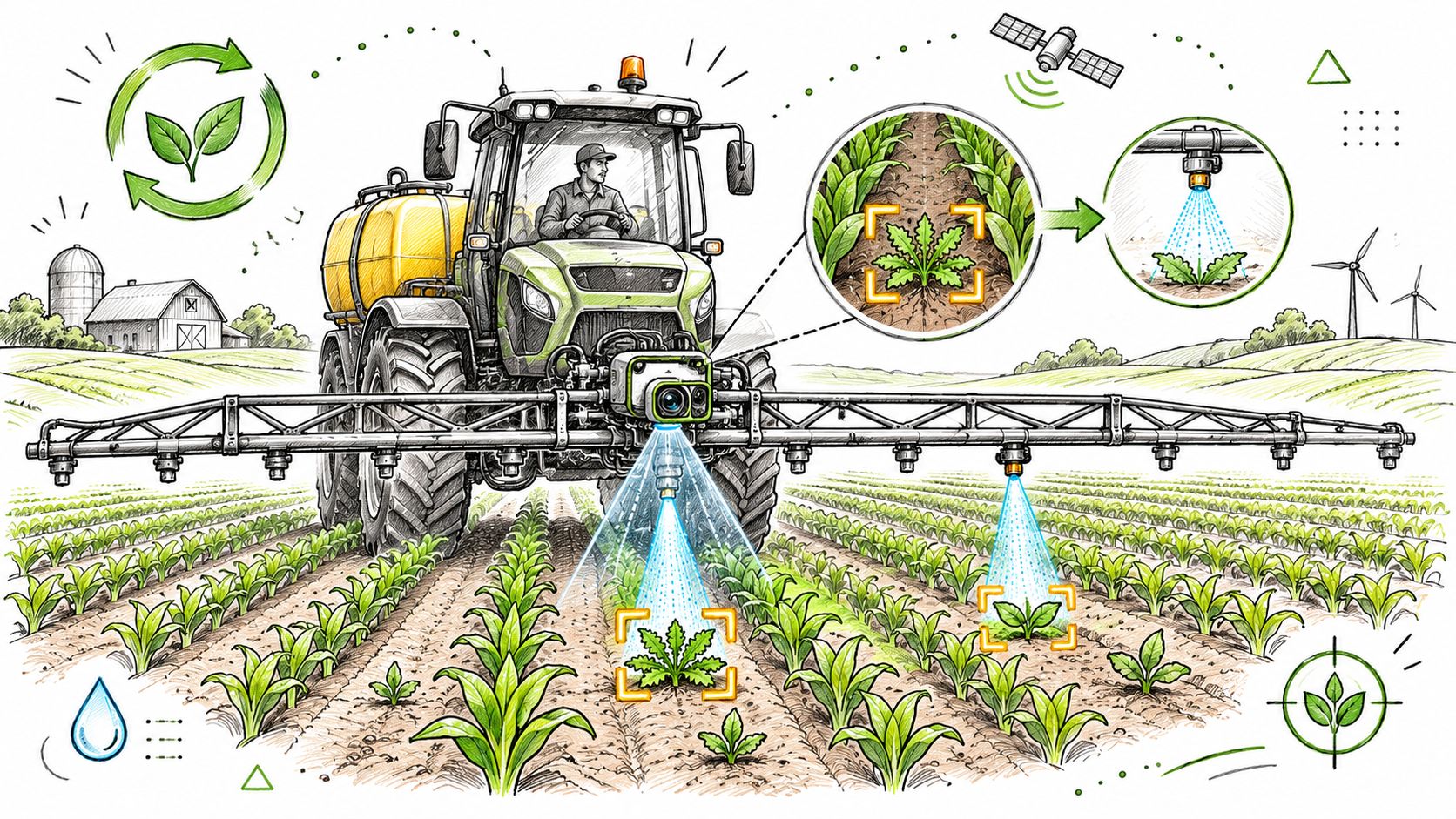
Broadcast spraying treats an entire field to kill weeds in patches. Camera-guided spraying treats the patch. A camera on the boom captures the row, a model separates crop from weed, and a nozzle fires only where it should. Blue River Technology's See and Spray, now part of John Deere, is the best-known commercial version. Field robots use the same vision stack to thin crops and target weeds in row crops.
What the camera has to survive
Dust on the lens, vibration from the boom, sun angle that shifts every twenty minutes, and ground speed that turns leaf edges into smears. At spraying speed, a rolling shutter produces leaf shapes no model was trained on, so global shutter is the default above walking pace.
Choose global shutter for anything faster than a walking pace.
Use RAW Bayer output when your model needs consistent color across changing light, and handle white balance downstream where you can version it.
Add controlled LED or NIR illumination for night spraying, which is when wind is often calmest.
Validate across crop stages. A model tuned on seedlings will misfire on a mature canopy with the same leaf area index.
The economics of this class of deployment, including adoption patterns across row crops, are summarized in how AI is used in farming.
9. Livestock and Crop Health Monitoring with Edge Vision
A strawberry robot is a fair test of whether an embedded camera can carry a real agronomic task. A robotic platform fitted with an RGB camera performed real-time, in-field diagnosis of strawberry foliar diseases at 91.10% precision and 88.50% recall while processing imagery at 76.50 frames per second (the peer-reviewed strawberry study). The frame rate is the number to notice. Diagnosis on a moving platform needs a continuous stream, not a still every few seconds.
Livestock monitoring has the same shape. A camera in a barn runs a pose or gait model continuously, counts animals, and flags lameness or abnormal behavior before a stockperson would catch it on a walk-through. In rural settings, edge processing also solves a bandwidth problem you can't buy your way out of.
Specify IP-rated housings and conformal coating. Ammonia, dust, and washdown destroy unprotected boards.
Match connectivity to the site. Wi-Fi where the barn has coverage, GigE where it doesn't; InnoWave-class models combine both in one unit.
Set exposure and HDR for mixed sun and shade along a greenhouse roof or an open-sided barn.
Mount above occlusion height and test coverage before the final install, because cattle move the furniture.
10. Drone-Based Infrastructure and Crop Inspection with Onboard AI
A transmission tower inspection used to mean a crew, a climb, and a notebook. Now a UAV with a high-resolution camera flies the span, and an onboard model flags insulators, clamps, and corrosion as it goes, so reviewers open flagged frames instead of every frame. Wind farm operators run the same pattern over blades, looking for erosion and cracks that are hard to see from the ground.
Compute budget is the constraint. An agricultural computer-vision study reported its AgroVisionNet model at 94.2% crop-disease classification accuracy against baselines of 87.8% to 91.3%, and showed it remained feasible for inference on an NVIDIA Jetson Nano using TensorFlow Lite (the study in Scientific Reports). That's the pattern to copy: a sensor sized to the task, paired with compute the airframe can lift and cool.
Work backward from ground sample distance. Decide the defect size you must resolve, then pick resolution and flight altitude together.
Use RAW output for radiometric or multispectral work where downstream processing depends on unmodified values.
Fly consistent altitude and overlap so repeat inspections are comparable across seasons.
Check aviation rules and permits before the first flight, not after the client signs.
Sizing rule: Resolution bought for its own sake just moves the bottleneck to storage and downlink.
11. How the Camera Choices Differ Across the 10 Embedded Vision Applications
Interface is the fork I lock first. It sets cable length, how you swap a failed camera, and whether inference sits on the sensor host or a remote PC. Resolution comes after that.
Application | Camera interface | First spec to lock | What that choice forces |
|---|---|---|---|
Drone visual obstacle avoidance and navigation | MIPI CSI-2 | Global shutter, then the shortest exposure the scene allows | Freezes close obstacles under vibration and a tight power budget. Dim air still starves the sensor. |
AMR and AGV navigation and obstacle detection | USB or MIPI CSI-2 | Field of view and camera count | Coverage beats extra megapixels in an aisle. Glare and repeating shelves still need a second view and a mount you can service. |
Kiosk audience analytics for digital signage | USB or MIPI | On-device person detection with anonymized output | Faces stay off the network. Glare and privacy rules still set lens and install height. |
Fixed-mount barcode and QR code reading at kiosks and point of sale | GigE Vision or ONVIF | Illumination and focus at the read plane | Resolution helps small codes. Screen glare and a short fixed-focus range still drop reads at the window edge. |
Point-of-care patient monitoring and fall detection | USB | NIR response and IR illumination level | Night monitoring without visible light. Occlusion and clinical validation still gate the release. |
Medical imaging for lab and point-of-care diagnostics | USB | RAW Bayer path and alignment tolerance | Pixel values stay usable for measurement. Regulatory evidence and a rigid optical stack matter more than digital zoom. |
Smart parking occupancy detection and license plate recognition | ONVIF or GigE | Dynamic range at the planned plate angle | Holds plates in headlight and shadow. Steep angles and night glare still cut the read rate. |
Precision agriculture weed and crop detection for smart spraying | GigE Vision | Global shutter timed to boom speed | Stops plant smear at field speed. Dust, vibration, and changing sun still shift color. |
Livestock and crop health monitoring with edge vision | Wireless or GigE | Power budget and IR reach | A weatherproof housing fails if the radio or illuminator browns out. Remote power and network drops remain the limit. |
Drone-based infrastructure and crop inspection with onboard AI | MIPI CSI-2 | Inference on the aircraft versus after landing | Onboard flags cut stored frames. Flight limits and raw volume still set endurance. |
Matching Camera Specs to Your Next Deployment
Start with the constraint that breaks first. Motion blur in a fast robot or a spraying boom points to global shutter and short exposures. A dark care room points to NIR sensitivity and IR illumination. Occlusion in a barn points to mounting height and coverage, not megapixels. A kiosk reading codes across a queue points to focal length and controlled light. Long cable runs in a checkout lane point to GigE.
Then write acceptance criteria that describe the deployment rather than the model. A useful template comes from transportation work: Delaware's AI-enabled integrated transportation management system was evaluated at better than 95% daytime accuracy for vehicle counting, speed measurement, and roadway-occupancy estimation, with incident-detection targets of at least 90% for major incidents, 85% for medium, and 75% for minor (FHWA's evaluation of the Delaware deployment). Those are per-class thresholds with a stated condition, which is what your own spec should look like: per-class metrics, confidence thresholds, alert latency, false-alarm rate, and performance split by day and night.
Three habits separate teams that ship from teams that re-spin hardware.
Benchmark on frames from your own site. Public datasets won't tell you how your sensor behaves under your sodium lamps.
Separate detection, tracking, and classification scores. A strong classifier on top of a weak tracker produces confident wrong answers.
Log timestamps end to end. Alignment with other sensors and with external event data is where integration projects fail.
Evaluation hardware matters as much as the sensor choice. Get a module on a dev board early, run your model against live frames, and only then commit to a custom carrier design. Teams that want help narrowing the options can reach Vadzo Imaging's Application Engineering Team through the contact form on the site, and evaluation kits and SDKs are available within 2 weeks.
Vadzo Imaging supplies embedded camera modules across USB, MIPI, GigE, Wi-Fi, and SerDes interfaces, with global shutter, HDR, low-light, RAW Bayer, and IR cut switchable options for the deployments covered here. If you're specifying a camera for a drone, robot, kiosk, medical device, parking system, or field unit, the team can help you match sensor, interface, and edge compute to your actual constraint. Visit Vadzo Imaging to browse the camera families, compare specs, and start a conversation with application engineering.
