High Dynamic Range Cameras in Embedded Vision: Principles, Sensor Design & Applications

Updated: 2 days ago

Understanding High Dynamic Range
Capturing both dark and bright regions of a scene without losing visual detail has always been a core challenge in imaging. Whether it’s sunlight streaming through a tunnel, reflective machinery in an inspection line, or shadowed subjects in outdoor environments, maintaining uniform clarity is difficult.
Dynamic range is the comparison between the brightest signal a sensor can record before it becomes saturated and the faintest signal it can detect above the noise level. When improvements are made in sensor design and computational techniques, the camera is able to reach High Dynamic Range (HDR) capabilities.
For embedded vision systems, High Dynamic Range is no longer optional; it’s a necessity. It enables consistent and reliable imaging for outdoor surveillance, factory automation, industrial inspection, and automotive vision.
Importance of High Dynamic Range in Modern Imaging
High Dynamic Range (HDR) technology allows cameras to effectively balance bright highlights and dark shadow areas within a single image, a task that traditional sensors often struggle with. In practical industrial settings such as manufacturing lines, busy traffic intersections, distribution centers, and outdoor monitoring, lighting conditions can vary significantly. Standard cameras typically capture only about 50–60 dB of dynamic range, which results in the loss of vital details in either overexposed bright spots or underexposed dark sections.
In contrast, HDR sensors are capable of capturing 100 dB or more, providing up to 1000× greater luminance range. This enhanced dynamic range enables imaging systems to retain intricate details throughout the entire scene, guaranteeing precise analysis, improved detection capabilities, and more dependable decision-making in difficult lighting situations.
What is an HDR Camera?
An HDR camera is specifically designed to capture a broader luminance range than standard cameras. It handles mixed or extreme lighting conditions, ideal for robotics, automotive vision, traffic monitoring, and machine inspection.
Core Components of an HDR Camera:
HDR Image Sensor – Captures multiple exposures or supports pixel-level HDR readout.
Image Signal Processor (ISP) – Manages functions like merging various exposures, implementing tone-mapping to ensure brightness is balanced, and modifying colors for precise output.
High-Speed Interface – USB 3.0, MIPI CSI-2, or FPD-Link interfaces handle large HDR data streams efficiently.
Performance Metrics
Engineers evaluate HDR cameras using:
Dynamic range (in dB) – HDR sensors typically deliver 100–120 dB; automotive sensors achieve up to 140 dB.
Signal-to-noise ratio (SNR) – Determines usable shadow detail.
Data transfer with minimal latency: HDR pipelines often handle multiple exposures per frame and high-bit-depth RAW data, so interfaces like USB 3.0, MIPI CSI-2, and GMSL/FPD-Link must maintain low-latency throughput to avoid bottlenecks that could slow downstream vision algorithms or edge inference.
Vadzo’s AR0233 HDR USB 3.0 camera is an example that integrates HDR with LED Flicker Mitigation (LFM), enabling stable results in automotive and industrial applications.
Principles of HDR Imaging
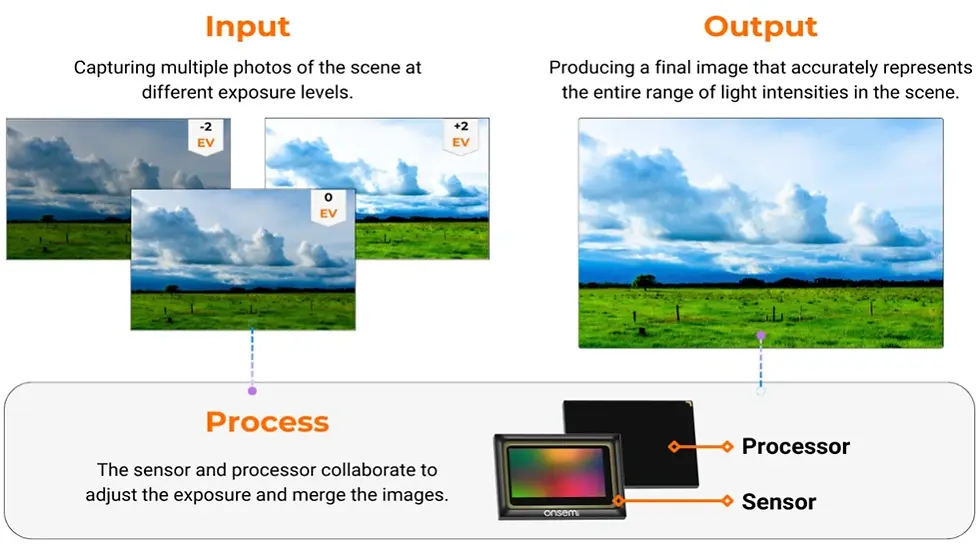
HDR imaging improves visual quality by skillfully merging several exposures of the same scene. Rather than depending on a single exposure, which often results in either blown-out highlights or overly dark shadows, High Dynamic Range cameras take multiple images at different exposure levels or use specialized sensors that allow for pixel-level exposure management. This blending technique uncovers details in both shadows and highlights, providing accurate visibility in real-world embedded systems where lighting conditions can be inconsistent. Consequently, HDR imaging guarantees excellent detail preservation across all brightness levels.
How it Functions
In a typical pipeline for HDR, the image sensor captures:
A brief exposure for bright areas,
A medium exposure for mid-tones, and
An extended exposure for darker regions.
An image signal processor (ISP) or a specific HDR algorithm combines these images, balancing brightness while maintaining contrast. The resulting image preserves complete color depth and texture, which is essential for inspection, monitoring, and AI-driven analysis.
HDR Technology Across Imaging Domains
Consumer & Broadcast Systems: From smartphone photography to professional broadcasting, HDR technology delivers lifelike color and depth. Standards such as HDR10 and Dolby Vision enhance contrast for vivid displays.
Embedded & Industrial Vision: In embedded and industrial settings, lighting conditions can change abruptly or be inconsistent throughout the scene. HDR technology aids in preserving consistent image quality by capturing details in both well-lit and shadowy areas at the same time. This capability enables factory robots, traffic monitoring systems, and autonomous machines to function dependably, even when encountering glare, dark areas, or reflective surfaces.
Medical & Scientific Imaging: In medical diagnostics and laboratory imaging, HDR is vital for maintaining fine details. It enables sensors to capture both bright and dark areas at the same time without losing highlights or compromising information in low-light conditions. This leads to clearer images that enhance observation, detection, and analysis accuracy.
HDR Sensor Architecture
The image sensor, which is at the core of any HDR camera, determines how effectively it captures wide brightness variations.
Core HDR Sensor Technologies:
Dual Conversion Gain (DCG): Each pixel dynamically switches between low and high gain to manage bright and dark details within one exposure.
Quad Exposure HDR: Used in sensors like Sony IMX900 and Onsemi AR0822, this captures up to four exposures simultaneously, pushing High Dynamic Range performance beyond 120 dB.
Split-Diode HDR: Divides each pixel into two photodiodes, recording separate intensity ranges in parallel, reducing motion blur and preserving edge sharpness.
Global vs. Rolling Shutter:
Global Shutter sensors capture all pixels simultaneously, ideal for fast-moving scenes requiring precise timing.
Rolling Shutter sensors capture line by line, suitable for moderate motion.
For high-speed robotics or automotive vision, HDR global shutter sensors deliver optimal performance and reliability.
HDR Image Processing Pipeline
Processing HDR data demands computational precision and real-time optimization.
Exposure Alignment: Synchronization between exposures is vital to prevent ghosting. Hardware triggers or global shutter sensors ensure precise timing.
Fusion Algorithms: Multi-exposure merging using gradient or bilateral weighting preserves detail and minimizes noise.
Tone Mapping: Compresses luminance values to fit display limits while retaining local contrast, a key step in HDR image processing.
Noise & Color Correction: Vadzo’s ISP pipeline employs adaptive denoising and color balance algorithms to retain natural tones.
Real-Time Processing: Platforms like NVIDIA Jetson and Qualcomm SoCs accelerate High Dynamic Range pipelines, achieving low-latency HDR streaming for embedded systems.
Benefits of High Dynamic Range in Embedded Vision
Enhanced Low-Light Capture: HDR sensors retain detail in both shadows and highlights.
Improved Object Detection: Enables AI models to identify objects accurately under mixed lighting.
Outdoor Reliability: High Dynamic Range imaging maintains visual stability through day–night cycles.
Safety-Critical Accuracy: Vital for robotics, surveillance, and automotive systems that depend on exposure precision.
Simplified Integration: Reduces reliance on artificial lighting or external filters.
Key Use Cases of High Dynamic Range Cameras
Automotive Vision: Handles tunnel transitions and headlight glare with clarity. Vadzo’s AR0233 delivers High Dynamic Range and LFM for ADAS systems.
Industrial Inspection: High Dynamic Range imaging prevents surface saturation and reveals fine defects.
Security & Surveillance: HDR technology allows surveillance systems to produce crisp images even in difficult lighting conditions, such as scenarios with strong backlighting or severe artificial light, ensuring essential details remain visible.
Smart Cities & Robotics: In metropolitan areas, lighting conditions can shift dramatically throughout the day and vary by location. HDR technology helps cameras in smart city infrastructure and autonomous robots achieve consistent exposure, facilitating reliable navigation, monitoring, and data gathering.
Implementation Challenges
While High Dynamic Range imaging improves output quality, engineers must balance:
Motion Artifacts due to exposure timing;
Data Bandwidth, as multiple frames increase throughput;
Processing Overhead from HDR fusion;
Power & Heat, especially in compact embedded devices;
Calibration, needed for consistent color and brightness alignment.
Vadzo Imaging High Dynamic Range (HDR) Camera Solutions
Vadzo Imaging provides a comprehensive range of High Dynamic Range (HDR) cameras designed for challenging embedded vision and industrial settings. These cameras are uniquely crafted to capture accurate, balanced images in environments with difficult lighting, ranging from brightly lit outdoor settings to dimly lit factory floors, or areas characterized by high contrast and reflective surfaces.

AR0233 Color 1080P HDR Camera – Precision Imaging for Dynamic Lighting
The AR0233 offers dependable 1080p color imaging with HDR capabilities, incorporating LED Flicker Mitigation (LFM) and superior low-light efficacy. Its capacity to sustain stable exposure amid swiftly changing lighting conditions makes it highly suitable for:
Automotive vision systems
Traffic surveillance and smart transport
Industrial inspection lines with fluctuating light levels
Featuring USB 3.0 connectivity and compliance with UVC standards, the AR0233 integrates effortlessly with Vadzo’s SDK, enabling engineers to implement HDR-enabled imaging systems swiftly without intricate firmware development.

AR0821 4K Fixed Focus HDR Camera
The AR0821 provides 4K resolution for applications requiring detailed image capture with accurate HDR performance. Its fixed-focus configuration guarantees clear, consistent images, even in challenging lighting situations. This camera is appropriate for:
Precise inspection systems
Robotics and automation that necessitate high visual precision
Imaging applications where intricate detail and dynamic range are essential
Engineers gain from plug-and-play USB 3.0 connectivity, complete UVC support, and Vadzo’s SDK resources, facilitating the rapid deployment of high-resolution HDR systems.

AR0822 4K HDR Camera
Engineered to function in extreme temperatures and difficult lighting conditions, the AR0822 provides 4K HDR imaging suitable for:
Outdoor surveillance and smart city initiatives
Industrial settings with variable lighting
Scenarios requiring dependable HDR imaging across a broad range of temperatures
Like other Vadzo HDR cameras, it supports USB 3.0 and UVC standards, ensuring seamless integration with Vadzo’s software ecosystem for quick system deployment.
Final Insights on High Dynamic Range Imaging
High Dynamic Range (HDR) allows cameras to clearly capture both bright and dark regions in the same shot. It is essential in current imaging systems used in factories, vehicles, and surveillance, ensuring that every image retains precise detail even when light levels change.
In embedded vision, HDR is important for achieving consistent and reliable image quality. It enables cameras to automatically adjust to different lighting conditions, providing engineers with accurate data for analysis, monitoring, and process management.
Vadzo Imaging incorporates HDR technology throughout its camera lineup, offering industrial and embedded users consistent performance, straightforward integration, and reliable imaging under any lighting situation, supporting developers in creating vision systems that operate reliably at all times, whether it’s day or night.


