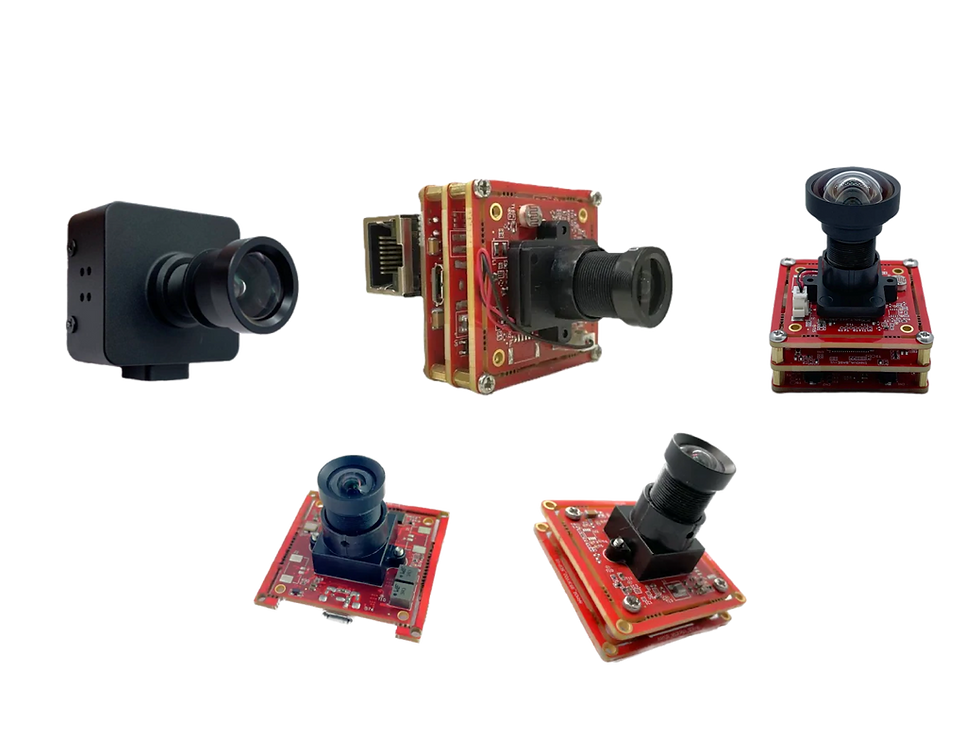
HDR Video Camera Portfolio
Choosing the Right HDR Video Camera for Your Application
Selecting the right HDR video camera can determine whether a vision system holds detail in bright highlights and deep shadows at the same time or loses it in both. Vadzo Imaging designs camera modules built around high dynamic range sensors, so engineers get clean, well-exposed frames straight out of the module instead of fighting exposure problems downstream in software. Whether the target application is outdoor surveillance, machine vision on a factory line, or a drone flying into direct sunlight, our portfolio covers the resolution, interface, and mounting options that demanding lighting conditions require.
HDR Camera Module: Built for Every Interface and Application
Vadzo Imaging camera modules are engineered around one goal keeping image quality steady when a scene holds both very bright and very dark regions at once. Every HDR Camera Module in the portfolio starts with a sensor chosen for wide dynamic range performance, then gets paired with the enclosure, lens mount, and interface a project calls for. Buyers evaluating a 2MP HDR Camera Module for compact embedded designs, a 5MP HDR Camera Module for balanced resolution and file size, an 8MP HDR Camera Module for detailed inspection work, a 13MP HDR Camera Module for high resolution capture, a 20MP HDR Camera Module for maximum detail, or a 4K HDR Camera Module for video heavy applications can match resolution to the job instead of paying for capability a project does not need. Each HDR Video Camera Module and HDR Camera Sensor Module in the lineup carries the same onboard tone mapping and exposure control that lets a single frame hold detail across a full range of lighting, and each is available as an OEM HDR Camera Module built to a customer's mechanical and electrical requirements.
HDR Video Camera Module Interfaces
Every HDR Video Camera Module in the Vadzo lineup is built around the interface a design actually needs. An HDR USB Camera Module plugs into a workstation or embedded host over USB 3.2 or USB 3.0 and needs no custom driver stack, which shortens bring-up time for benchtop testing and light industrial use. An HDR MIPI CSI Camera Module connects directly to the camera connector on a system-on-module or single-board computer for the lowest-latency path into the image signal processor, a common requirement in robotics and drone payloads. An HDR GigE Camera Module extends that same image data over a standard Ethernet cable for installations where the sensor sits meters away from the processing unit, while an HDR Wi-Fi Camera Module removes the cable entirely for mobile or hard-to-reach mounting points. For automotive and ruggedized designs, a serializer-deserializer link carries the camera output over coax cable across long distances without the signal loss a ribbon cable introduces. Whichever HDR Camera Module USB Interface, MIPI, GigE, Wi-Fi, or SerDes option a project settles on, Vadzo Imaging validates the driver package and reference design before the module ships, so our HDR cameras reach first frame in hours rather than weeks.
HDR Camera Module for Machine Vision, Robotics, and Embedded Systems
An HDR Camera for Machine Vision has to hold detail on a bright reflective part and the shadowed inside of a fixture at the same time, and that is exactly the scenario Vadzo Imaging designs for. An HDR Camera for Embedded Vision brings that same wide dynamic range performance to a system-on-module or carrier board running a full perception stack, while an HDR Video Camera for Industrial Use keeps a production line running through the mixed lighting a factory floor produces across a full shift. An HDR Camera Module for Robotics handles manipulation and navigation tasks on arms and mobile bases where a scene can shift from bright window light to a dark shelf in a single frame, and an HDR Video Module for Embedded Systems gives integrators a compact building block for exactly that kind of variable lighting. A well-designed HDR video camera keeps critical highlight and shadow detail visible at once, which is often the difference between a vision model that performs well in a lab and one that holds up on a factory floor or a job site.
Why Choose Vadzo Imaging for Your Next HDR Camera Project
Vadzo Imaging has spent years building embedded vision hardware for OEMs and system integrators, and that experience shows every module released. Few companies validate their HDR cameras across as many interfaces, resolutions, and mounting formats as Vadzo Imaging does, and the engineering team backs every customer relationship as an HDR Camera Module Manufacturer with direct technical support rather than a support ticket queue. When a design partner is comparing options and wants the Best HDR Camera Module for a specific application, whether that means the widest dynamic range, the smallest footprint, or the fastest path to first frame, Vadzo Imaging is the name that keeps coming up. The catalog is broad enough that switching resolution or interface mid-project does not mean switching vendors, and every OEM HDR Camera Module shipped is proven on real hardware rather than a datasheet promise.
Vadzo HDR Camera Portfolio
USB 3.2 Gen 2x2 Interface (Vajra Series)
Model | Sensor | Resolution | Shutter | Chroma | Buy Now |
|---|---|---|---|---|---|
Vajra-821CRS | onsemi AR0821 | 8MP | Rolling | Color |
MIPI CSI-2 Interface (Bolt Series)
Model | Sensor | Resolution | Shutter | Chroma | Buy Now |
|---|---|---|---|---|---|
Bolt-2020CRS | onsemi Hyperlux AR2020 | 20MP | Rolling | Color | |
Bolt-1335CRS | onsemi AR1335 | 13MP | Rolling | Color | |
Bolt-821CRS | onsemi AR0821 | 8MP | Rolling | Color | |
Bolt-822CRS | Onsemi Hyperlux AR0822 | 8MP | Rolling | Color | |
Bolt-830CRS | onsemi Hyperlux AR0830 | 8MP | Rolling | Color | |
Bolt-233CRS | onsemi AR0233 | 2MP | Rolling | Color | |
Bolt-246CRS | onsemi Hyperlux AR0246 | 2MP | Rolling | Color |
GigE Interface (Innova Series)
Wi-Fi Interface (Wave Series)
FPD-Link III Interface (Armor Series)
USB 2.0 Interface (Merlin/ MerlinPlus Series)
USB 3.2 Gen 1 Interface (Falcon Series)
Model | Sensor | Resolution | Shutter | Chroma | Buy Now |
|---|---|---|---|---|---|
Falcon-2020CRS | onsemi AR2020 | 20MP | Rolling | Color | |
Falcon-1335CRS | onsemi AR1335 | 13MP | Rolling | Color | |
Falcon-821CRS | onsemi AR0821 | 8MP | Rolling | Color | |
Falcon-822CRS | onsemi Hyperlux AR0822 | 8MP | Rolling | Color | |
Falcon-830CRS | onsemi Hyperlux AR0830 | 8MP | Rolling | Color | |
Falcon-246CRS | onsemi Hyperlux AR0246 | 2MP | Rolling | Color |
Quick Samples Dispatch
Find the Right Camera for Your Project Today.
Samples procured typically ship within 5-7 business days of order confirmation, with tracked international shipping. Compressed development timeline? You can be capturing frames from a Vadzo camera the same week you shortlist it.
RoHS 3 · REACH · NDAA (Selected Models)
No MOQ (Minimum Order Quantity)
Ships Worldwide
Frequently Asked Questions
1.What is an HDR video camera module?
An HDR video camera module pairs with a wide dynamic range of image sensors with onboard tone mapping, so a single frame holds detail in both bright highlights and deep shadows at the same time. Standard sensors clip one end of that range or the other in high contrast scenes, while an HDR sensor captures multiple exposures per frame and blends them before the image reaches the host processor. Vadzo Imaging builds these HDR cameras across USB, MIPI, GigE, Wi-Fi, and FPD-Link III interfaces, so the sensor technology fits directly into an existing design.
2.How does HDR (High Dynamic Range) imaging work in a camera module?
HDR imaging works by capturing a scene at more than one exposure level within the same frame interval, then combining those exposures into a single output image. A short exposure preserves detail in bright areas that would otherwise wash out, while a longer exposure pulls detail out of shadows that would otherwise go black. The sensor or an onboard image signal processor merges these exposures line by line or frame by frame, so the final output keeps a wider range of brightness than any single exposure could capture on its own.
3.What is tone mapping and why is it important for HDR output?
Tone mapping takes the wide brightness range captured by an HDR sensor and compresses it into a range a standard display or video pipeline can show without losing the highlight and shadow detail that made the capture worthwhile. Without tone mapping, a raw HDR frame can look flat or oversaturated once it leaves the sensor. Vadzo Imaging tunes tone mapping curves per sensor and per application, so a machine vision camera and a security camera built on the same sensor can each be optimized for the scene they actually face.
4.How do I choose the right HDR camera module for my application?
The right choice starts with the scene, not the spec sheet. A factory floor with mixed indoor and outdoor lighting calls for different wide dynamic range and rolling shutter tradeoffs than a robotics arm that also needs a global shutter to avoid motion blur. Resolution and interface follow from there, matching a 2MP or 8MP sensor to the detail a task actually requires and matching USB, MIPI, GigE, or Wi-Fi to how far the camera sits from its host processor. Vadzo Imaging's engineering team works directly with customers to match sensors, resolution, and interface to the application before a design is locked in.
5.Where can I buy Vadzo Imaging HDR camera products for OEM integration?
Vadzo Imaging camera products are available directly through vadzoimaging.com, with full specifications, drivers, and datasheets published on each product page. Customers can also reach the engineering team before purchasing to confirm sensor, interface, and mechanical compatibility for a specific project, which is something a marketplace listing alone cannot offer.