HDR Imaging: How It Works and Why It Matters for Embedded Vision

Updated: Sep 26
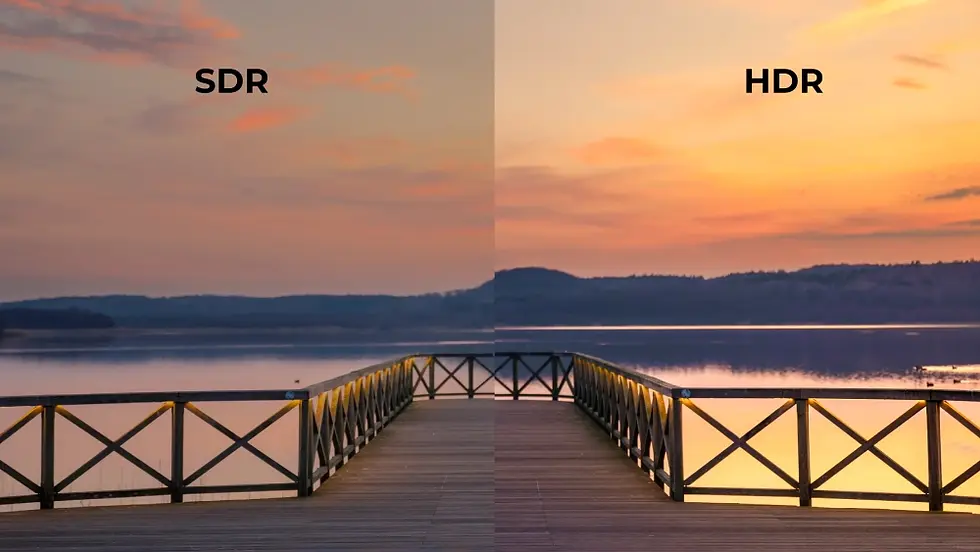
High Dynamic Range (HDR) imaging is a technology that allows cameras to capture a wider range of brightness than traditional imaging systems. By keeping detail in both very bright and very dark areas, HDR imaging makes sure that key scene information is maintained. This feature is essential for applications like embedded vision, industrial inspection, automotive safety, robotics, and surveillance, where lighting conditions can change significantly across the field of view.
Fundamentals of HDR Imaging
Conventional cameras often struggle in high-contrast settings. This leads to overexposed highlights or underexposed shadows. HDR imaging solves this problem by expanding the camera’s dynamic range. It allows the camera to capture scenes more realistically.
HDR imaging not only improves visual quality but also boosts the performance of machine vision algorithms. These algorithms need consistent image data for tasks like object detection, measurement, and defect analysis. Keeping details across the scene helps ensure higher accuracy and reliability in real-world embedded applications.
Key benefits include:
Preservation of important details in both shadows and highlights.
Improved performance for industrial and embedded vision tasks.
Realistic representation that closely matches how humans see.
Core Principles of HDR Imaging
HDR imaging is about capturing and showing the full range of brightness in a scene. To do this, it is essential to convert raw sensor data into a linear radiance format. This helps ensure that brightness is recorded accurately before any further processing or display.
Approaches to HDR capture:
Multi-Exposure HDR: This method combines several frames taken at different exposures. It uses underexposed images for highlights, overexposed images for shadows, and mid-exposure images for midtones to create one HDR image.
Sensor-Level HDR: This approach uses certain sensor designs to capture multiple intensity levels for each pixel at the same time. Examples include:
Dual-Gain / Dual-Conversion Gain (DCG)
Digital Overlap HDR (DOL-HDR) for rolling shutter sensors
Per-Pixel Quad HDR for simultaneous multi-exposure readouts
Sensor-level HDR is especially useful for motion-sensitive or real-time applications. It prevents ghosting issues and keeps high frame rates, which are important in areas like automotive vision, robotics, and embedded inspection systems.
HDR Capture Techniques
Multi-Exposure HDR:

Multi-exposure HDR involves capturing several frames at different exposure settings and combining them. Each exposure contributes uniquely:
Underexposed frames preserve highlight details.
Overexposed frames reveal shadow details.
Mid-exposure frames maintain midtone fidelity.
While effective, this method can be prone to motion artifacts such as ghosting if objects move between exposures. It also requires more processing power and memory, which can be a limiting factor for embedded systems.
Sensor-Level HDR
Sensor-level HDR captures multiple exposures simultaneously at the pixel or sensor level. Techniques include dual-gain readouts, digital overlap HDR, or per-pixel Quad HDR. Advantages include:
Elimination of temporal misalignment in moving scenes.
Real-time HDR capture at full frame rates.
Reduced computational load for embedded vision systems, as HDR fusion can be partially performed on-chip.
Sensor-level HDR is ideal for scenarios where high-speed imaging, motion tolerance, and precise luminance representation are required.
Exposure Control Logic
Exposure management is critical in HDR imaging to ensure accurate scene capture. Auto-Exposure Bracketing (AEB) is commonly used in multi-exposure HDR, automatically selecting optimal exposure levels for each frame. In sensor-level HDR, per-pixel or region-based exposure adjustments are employed to balance highlights and shadows efficiently.
Additionally, motion detection and compensation help reduce ghosting in multi-exposure HDR setups. Advanced embedded systems may also incorporate adaptive exposure algorithms that adjust gain dynamically based on real-time scene analysis.
Performance Metrics for HDR Imaging
Evaluating performance involves several key parameters:
Dynamic Range: The effective range of brightness captured. Modern sensors achieve over 100 dB, which is much higher than standard imaging.
Signal-to-Noise Ratio (SNR): This ensures shadows and low-light areas retain usable detail without too much noise.
Motion Artifact Management: Multi-exposure HDR can cause ghosting; sensor-level HDR reduces these artifacts.
Processing and Memory Requirements: Multi-frame HDR raises storage and processing demands, while sensor-level HDR lowers on-device computation but requires handling high bit depth.
Tone Mapping Efficiency: This method converts HDR brightness to a displayable range while keeping local contrast and details intact.
Real-World Applications of HDR Imaging
HDR imaging has transformed numerous industries:
Industrial Inspection: Detects defects and surface irregularities even under highly reflective or shadowed conditions.
Embedded Vision & Robotics: Enables accurate object detection and scene understanding in variable illumination.
Surveillance & Security: Captures facial or license plate details under mixed lighting or backlit environments.
Scientific & Medical Imaging: Maintains subtle intensity variations, supporting precise analysis and diagnostics.
Challenges in HDR Imaging
Despite its advantages, it introduces several challenges:
Motion Artifacts: Multi-exposure HDR can produce ghosting in dynamic scenes.
Noise Management: Shadow amplification and tone mapping can exaggerate noise.
Computational Overhead: Multi-frame HDR increases processing and memory demands.
Display Limitations: SDR displays require tone mapping, which can reduce perceived detail.
Visual Realism: Excessive tone mapping may result in an unnatural HDR look.
Summary
HDR imaging ensures precise and high-quality capture of high-contrast scenes. By combining multi-exposure or sensor-level capture, smart exposure techniques, and improved processing, HDR imaging keeps important details in both shadows and highlights. For embedded systems, industrial inspection, surveillance, and high-end imaging applications, HDR imaging is crucial to achieve trustworthy, realistic, and high-quality results.
Explore Vadzo Imaging’s HDR-capable cameras for superior performance in challenging lighting conditions.


